
When the Oil Headline and the Freight Headline Don’t Share a Trade Route
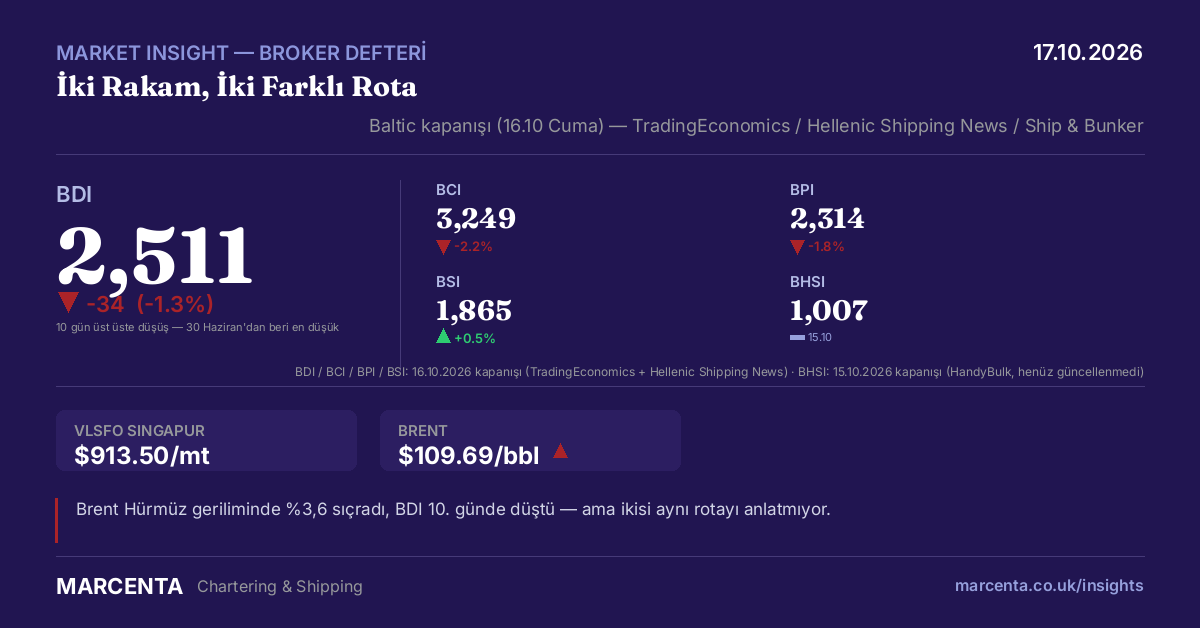
Friday gave the market two big numbers moving in opposite directions. Brent crude rose 3.6% to $109.69/bbl on reports of rising tension around the Strait of Hormuz (Ship & Bunker, cross-checked against TradingEconomics). The Baltic Dry Index fell for the tenth consecutive session, closing at 2,511, down 1.3% and its lowest close since June 30 (TradingEconomics, cross-checked against Hellenic Shipping News).
The instinct is to link them: Gulf tension, oil spikes, so dry bulk must be getting riskier too. It's a reasonable-sounding chain, and it's mostly wrong for this market. Iron ore, the single biggest driver of Capesize demand, moves almost entirely on the Australia/Brazil to China route. It has no meaningful exposure to Hormuz. The strait matters to dry bulk mainly through fertiliser cargoes out of Qatar and Saudi Arabia, grain, and LPG/LNG flows, not the big-gearless iron ore trade that sets the tone for the headline index.
What the BDI drop actually shows is narrower than the headline suggests. Capesize fell 2.2% and Panamax 1.8%, both weighed down by soft Chinese steel demand and a glut of ballasters. Supramax held up, up 0.5%. Handysize was last reported Thursday at 1,007 (HandyBulk hasn't published Friday's print yet), so treat that number as a day old, not current. The weakness is real, but it sits mostly in the big-ship, iron-ore-and-coal end of the market, not across the board.
Where oil and freight do connect is cost, not risk. A pricier barrel raises bunker costs for every owner on the water right now, at the exact moment freight rates are sliding. That's a genuine squeeze on break-evens, just not the one the headline implies. No confirmed transit disruption has been reported. For now this is a pricing and risk-premium story, not a physical one, and the two numbers on your screen this morning are describing two different trades, not one.