The Missing GM: What the Vanishing of the SS Waratah Teaches Modern Chartering Desks
Chartering Insights, Chartering Knowledge, Chartering Strategy, Operational Risk, Phantom Ships, Risk Management in Trade, Ship Chartering #ShipWithMarcenta, Hague-Visby Rules, Marine Insurance Litigation, Metacentric Height, Seaworthiness, Ship Stability, SS Waratah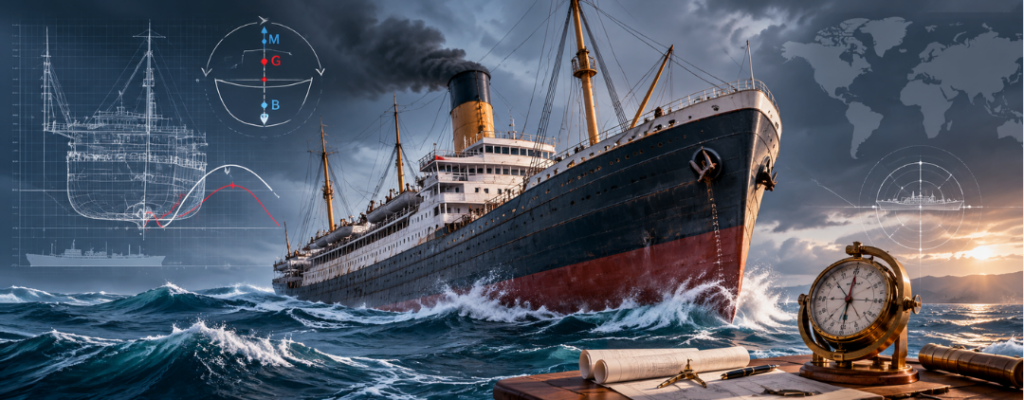
In modern dry bulk operations, we treat stability calculations as an automated formality. Our loadicator software flashes green, the chief officer signs the stability matrix, and the vessel departs. We assume that if a ship is built by a reputable yard and classed by a major society, her fundamental physics are unassailable.
However, maritime history has a brilliant, albeit tragic, way of proving that a ship can be brand new, perfectly maintained, and still be a floating death trap due to a single hidden parameter: The Metacentric Height ($GM$).
Every year, as we review operational risks at sea, the ghost of the SS Waratah stands out as the ultimate warning. Dubbed the “Titanic of the South,” this 500-foot flagship vanished without a single trace, debris field, or distress signal off the wild coast of South Africa in July 1909, while carrying a heavy, dense cargo of lead ore, concentrates, and wool from Australia to London.
While early commentators blamed a freak wave, the subsequent London Board of Trade inquiry uncovered a far more terrifying, structural reality—an inherent blueprint flaw that turned the ship into an unstable pendulum.
The Technical Post-Mortem: The Top-Heavy Passenger Liner
During her maiden voyage, passengers noticed that the SS Waratah possessed an extraordinarily slow, sluggish roll. When she leaned into a turn or met a wave, she stayed listed for a prolonged, agonizing duration before slowly righting herself.
In naval architecture, this behavior is a textbook indicator of a dangerously low Metacentric Height ($GM$).
$$\text{Metacentric Height } (GM) = KM – KG$$
Where $KM$ is the height of the metacenter and $KG$ is the height of the center of gravity.
If a vessel is designed with too much top-weight—such as adding extensive passenger decks above the waterline without widening the beam—the center of gravity ($G$) rises dangerously close to the metacenter ($M$).
When the $GM$ value approaches zero or becomes negative, the ship loses her righting lever ($GZ$). If hit by a heavy beam sea or if a high-density cargo like lead ore shifts slightly in the lower holds, the vessel will not recover; she will turtle instantly and sink within sixty seconds, trapping everyone inside.
The Stability Collapse Matrix:
┌────────────────────────────────────────────────────────┐
│             Vessel Design with High Top-Weight         │
└───────────────────────────┬────────────────────────────┘
                            │
              Cargo loaded into upper decks
            ┌───────────────┴───────────────┐
            ▼                               ▼
     [ Center of Gravity (G) Rises ] [ Righting Lever (GZ) Flattens ]
                            │
                            ▼
                Metacentric Height (GM) → 0
                            │
                            ▼
               [ THE CATACLYSMIC THRESHOLD ]
           Freak Wave or Minor Cargo Shift Results in
          Instantaneous Capsizing & Immediate Sinking.
The Legal Fallout: The Non-Delegable Duty of Seaworthiness
For modern charterers and cargo underwriters, the SS Waratah disaster represents the definitive battleground for the Absolute Clause of Seaworthiness. Under English Maritime Law and modern frameworks like Article III(1) of the Hague-Visby Rules, a Shipowner has a strict, non-delegable obligation to exercise due diligence to ensure the vessel is seaworthy before and at the beginning of the voyage.
- The Blueprint Trap: If a vessel is unseaworthy due to a design flaw or an inherent stability defect born on the drafting table, the Owner cannot shift the blame to the shipbuilder or the classification society. The liability for any resulting total loss of cargo rests entirely on the Owner’s balance sheet.
- The Cargo Shift Link: If a charterer provides a high-density mineral cargo that shifts due to improper trimming, but the ship capsizes because her baseline design stability ($GM$) was already insufficient to withstand a minor shift, London maritime arbitrators will look for the proximate cause. A ship that cannot survive a routine cargo shift in a storm is legally unseaworthy.
How Marcenta Enforces Stability Standards
The ironical reality of modern chartering is that standard operations desks only look at a ship’s deadweight, draft, and crane capacities when fixing a voyage. They completely ignore the vessel’s stability track record, ballast tank configurations, and technical management pedigree.
At Marcenta, when we implement our philosophy of Where cargo meets the right vessel, we dig deep into the operational profiles of the tonnage we secure for your complex dry bulk trades.
We perform due diligence on the shipowner’s technical managers, ensuring that when your dense ores or structural cargoes are loaded, the vessel maintains a healthy, robust Metacentric Height capable of defying the worst swells the ocean can throw at her. We insulate your capital from blueprint risks and operational shortcuts, ensuring your cargo travels on a stable foundation.
To access our current, fully pre-screened fleet directory and secure reliable tonnage for your upcoming heavy mineral transits, visit our live Market Insight & Activity portal.
For original archival court transcripts, maritime stability indices, and full historical investigation reports from the 1910 London hearings on the loss of the vessel, consult the digital archives of the National Maritime Museum in Greenwich.
#ShipWithMarcenta