
Newcastlemax Owners Are Pricing a Different Market Than the Spot Rate Suggests
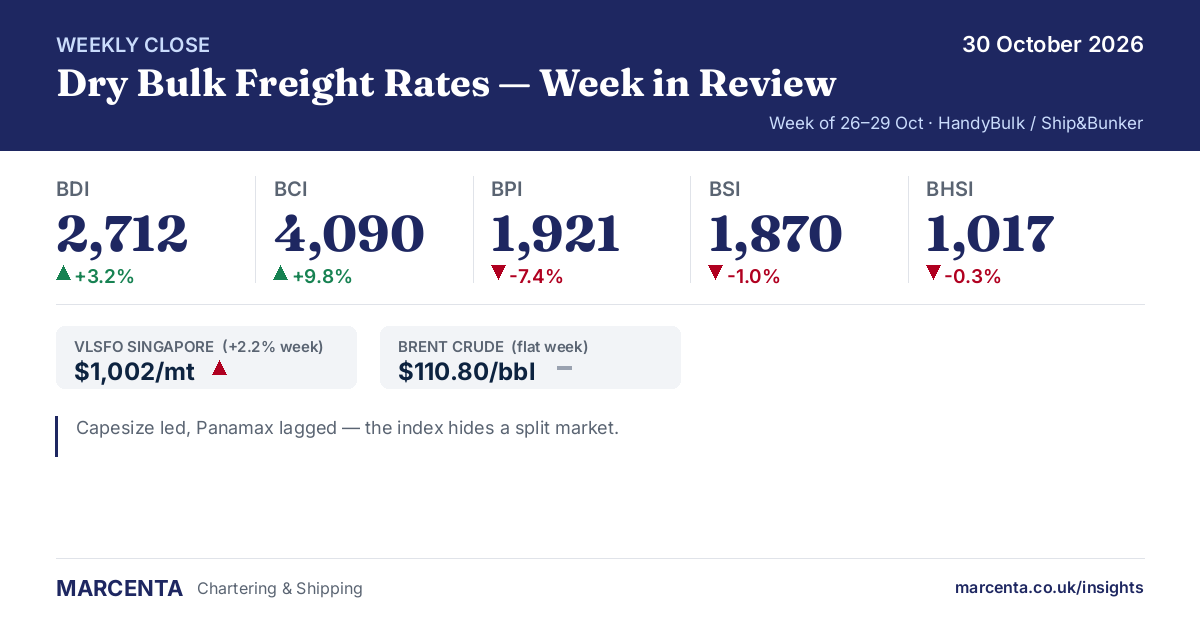
The Baltic Dry Index closed the week at 2,712, up 3.2% from Monday's 2,628 (tradingeconomics.com / hellenicshippingnews.com, cross-checked, 29.10.2026). On its own that reads as a steady week. It isn't. Capesize added almost 10% (3,726 to 4,090) while Panamax lost more than 7% (2,075 to 1,921), and that split has already been the running story on this page all week, so repeating it here adds little.
What's more interesting sits one layer down, in Fearnleys' Week 44 report (28.10.2026, via hellenicshippingnews.com). Capesize spot on the Continent/Far East run is fixing at USD 64,611/day, the kind of number that moves with sentiment week to week. The one-year period rate for standard Capesize tonnage is USD 32,494/day. For Newcastlemax, the one-year period rate is USD 44,636/day, about 37% above the Capesize period number. Owners committing larger, newer tonnage for a full year aren't pricing off this week's spot rally. They're pricing a structural premium that the spot noise doesn't explain, and it's worth watching whether that gap holds or narrows once the current rally cools.
Panamax tells a regional story the headline figure hides entirely. Transatlantic round voyage is sitting at just USD 15,845/day, well under the USD 24,538/day on the Continent/Far East TCE. The weakness in the index is coming out of the Atlantic, not the Pacific, and a broker reading BPI alone would miss that the two basins are behaving quite differently right now.
Port congestion adds a third thread, and it ties back to something we flagged here on Thursday: Tubarão's waiting times for mid-size tonnage have roughly tripled since September, while the big Newcastlemax/VLOC berths kept moving normally. We checked the anchorage again this morning and the picture hasn't shifted. A Panamax has now been sitting there for about 24 days, a Newcastlemax at berth for roughly 45. That's a thin sample on its own, but it lines up with the monthly trend rather than contradicting it, which points to a backlog building at one terminal rather than a single vessel skewing the numbers, and that kind of congestion doesn't usually clear in a few days. Whether it eases or deepens into next week will say a lot about how much of the Capesize strength is real demand pulling through versus a queue still working itself out.
Bunker moved the same direction as the rally this week: VLSFO in Singapore is up 2.2% to USD 1,002/mt (shipandbunker.com, 29.10.2026), with Brent essentially flat at USD 110.80/bbl (investing.com, 29.10.2026). For anyone fixing Capesize tonnage into next week, that's a cost line worth watching alongside the rate itself.