
Newcastle Queues Triple as Capesize Pulls Away From Panamax
The Baltic Dry Index closed last week at 2,714, barely moved from Thursday's number (+0.1%), but that flat headline is hiding a split that matters more than the index itself. Capesize (BCI) rose 0.9% on Friday alone and is up from 3,791 to 4,126 over the week, a solid run. Panamax (BPI) did the opposite: it fell for a seventh straight session, closing at 1,889, down 10.4% over the same week (tradingeconomics.com, hellenicshippingnews.com, 30.10.2026).
The Capesize strength lines up with our own rota_referans data. C3 (Tubarão to Qingdao) was quoted at 30.0 USD/mt and C5 (Port Hedland to Qingdao) at 11.25 USD/mt on 29.10.2026 (handybulk.com) — both iron ore benchmarks, both consistent with an index being pulled up by the big ships rather than the market as a whole. Supramax (BSI) only edged down 0.3% on the day, so the weakness really sits with Panamax.
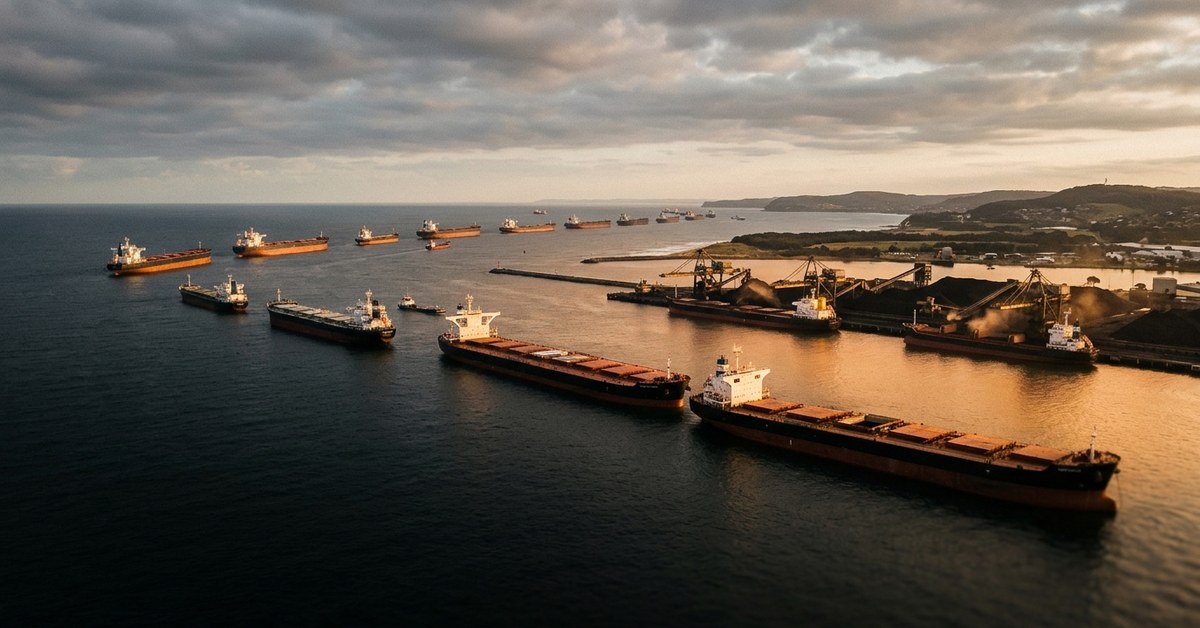
There's a port-side detail from our own AIS data that helps explain some of it. The median wait for Panamax and Kamsarmax vessels at Newcastle went from 1.7 hours in September to 30.1 hours in October, based on 109 vessel calls. That's a real slowdown on the coal loading side, and congestion like that tends to tie up tonnage until it suddenly comes free — which can show up as softer rates once it does.
On bunkers, VLSFO in Singapore closed at 1,019.50 USD/mt (+1.75% on the day) and Rotterdam at 794.50 USD/mt (+2.1%), with Brent up 2.4% to 113.43 USD/barrel (shipandbunker.com, investing.com, 30.10.2026). Anyone quoting longer-haul business this week should make sure the bunker assumption in the voyage estimate reflects Friday's numbers, not last week's. One gap worth flagging honestly: Handysize (BHSI) is still showing 1,015, last updated 29.10 rather than 30.10 — handybulk.com hasn't refreshed it, a recurring issue with that particular sub-index.
Two things we're watching this week to see whether the Cape/Panamax split holds or narrows: China's November iron ore import and port stock figures, which will say a lot about whether the demand behind the Capesize run has legs; and early movement in the Northern Hemisphere grain season out of the Black Sea and the US Gulf, which should help tell us whether the Panamax and Supramax softness is a demand problem or just too much tonnage chasing too little cargo.