
The MV Joyita: The Sarcastic Irony of the ‘Unsinkable’ Merchant Hull
English Law, Ghost Ships, Marine Insurance, Maritime History, Maritime Law, Navigation & Safety, Operational Risk, Risk Management in Trade, Shipbroking Insights #ShipWithMarcenta, Ghost Ship, Hull Insurance, Marine Insurance, Maritime History, Maritime Law, Maritime Mystery, Merchant Vessel, MV Joyita, Operational Risk, Premature Abandonment, Seaworthiness, Shipbroking, Shipping Safety, South Pacific Shipping, Unsinkable Ship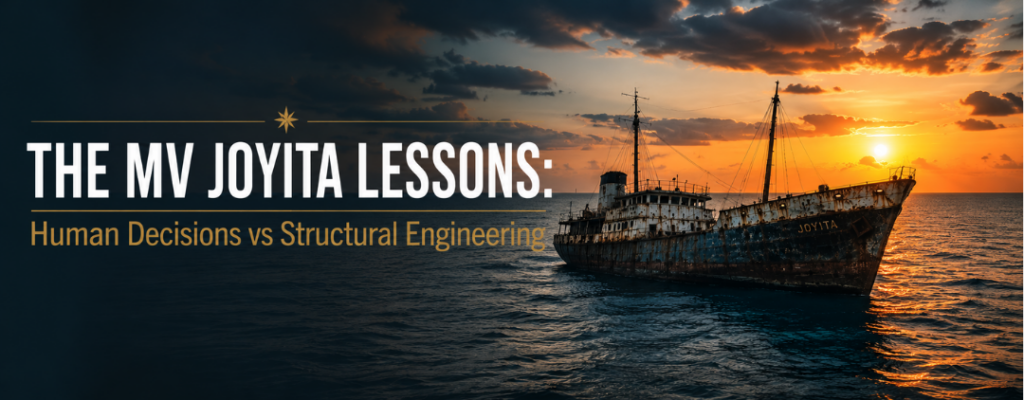
In the modern dry bulk and logistics sectors, we rely heavily on continuous telemetry. We monitor engine temperatures, hull stress levels, and satellite tracks. We live in an era where data makes the unknown look small. Yet, maritime history has a habit of presenting us with anomalies that completely defy logic, proving that the finest contractual clauses and structural designs are only as good as the human decisions behind them.
Consider the baffling case of the MV Joyita—the merchant ship that was legally and physically classified as “unsinkable,” yet was found drifting in 1955 as a ghost ship, entirely devoid of her crew and cargo.
The Structural Fortress That Couldn’t Sink
The MV Joyita was a 21-metre wooden merchant vessel operating in the South Pacific. Her secret? Her hull was lined with cork insulation intended for refrigeration, effectively making her a giant, floating cork.
In October 1955, she departed Samoa for a short, 48-hour commercial transit to the Tokelau Islands, carrying 25 passengers and crew, alongside a cargo of medical supplies, timber, and empty oil drums. She never arrived.
The 5W1H of a Maritime Phantom
- Who: The MV Joyita, a highly stable, cork-lined merchant vessel.
- What: Disappeared completely, only to be found drifting 5 weeks later, partially flooded and listing heavily—but completely afloat. All 25 souls were missing.
- Where: The remote expanse of the South Pacific Ocean.
- When: October 1955.
- Why it defies logic: The ship’s pipes had leaked, causing water to enter the bilges. Because the engines failed, the master could not pump the water out. However, due to her cork lining, the ship could not sink.
- The Fatal Decision: For reasons that still spark fierce debate in London maritime courts, the crew and passengers panicked and abandoned a perfectly buoyant ship to get into rubber liferafts. The rafts sank; the “broken” ship stayed afloat.
The Legal and Insurance Debacle
When the salvage tugs finally towed the empty Joyita into port, the maritime investigation opened a Pandora’s box. The cargo of medical supplies and timber had been systematically stripped, yet the logbook and navigation equipment were gone.
Under marine insurance parameters, the case became a legendary study in premature abandonment. If a master abandons a vessel that is structurally sound and incapable of sinking, do the hull underwriters bear the liability for the total loss of life and cargo, or does it fall under gross negligence?
The Modern Lesson for 2026 Chartering
The sarcastic truth of the MV Joyita is that the safest place for the crew was the very ship they fled. At Marcenta, when we look at Where cargo meets the right vessel, we don’t just audit the age of the hull or the name of the owner; we evaluate the operational culture.
A vessel is only as reliable as her command structure and her pre-voyage maintenance. By ensuring that our freight market intelligence pairs your cargo with strictly audited, highly professional operators, we minimize the risk of operational panic. We keep your cargo on course, ensuring that your fixtures are backed by sound logic, not historical mysteries.
To view our current, fully audited vessel availability and secure cargo flows for the weeks ahead, visit our live Market Insight & Activity board.
For historical records on maritime inquiries, salvage claims, and mid-century South Pacific shipping logs, the National Archives of New Zealand houses the official Joyita commission files.
If you were the Cargo Owner in 1955, and your legal team discovered the captain sailed with only one functioning engine and a broken radio, would you sue the hull owners for breach of the ‘implied warranty of seaworthiness,’ or accept it as a freak accident of the Pacific? Let us know your legal take.
#ShipWithMarcenta