
Iron Ore Is Cheaper. So Why Is Capesize Climbing?
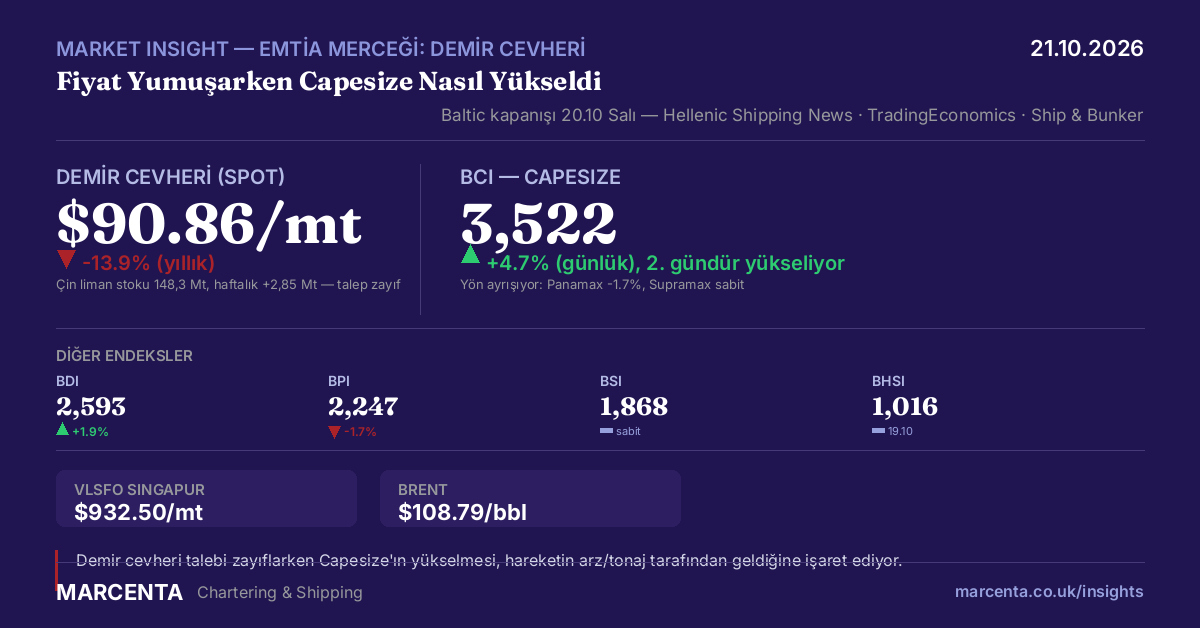
Capesize just had its best two sessions in weeks. The index rose 4.7% on Tuesday to 3,522 points, on top of Monday's 3.6% gain. The Baltic Dry Index followed, up 1.9% to 2,593, a near one-week high (Hellenic Shipping News, balticdryindex.com, 20.10.2026).
Normally a Capesize rally tracks more iron ore moving. The cargo numbers say otherwise. Spot iron ore sits at $90.86/mt, down almost 14% over the past year and roughly flat today (TradingEconomics, 21.10.2026). Stockpiles at 35 major Chinese ports rose 2.85 million tonnes week on week to 148.3 million tonnes as of 16 October, while average daily outbound volume from those ports fell by 50,000 tonnes. Steel mills are reporting losses (SMM data, via Hellenic Shipping News, 20.10.2026). None of that reads like fresh demand.
The rest of the Baltic complex agrees with the cargo data, not the index. Panamax fell 1.7% to 2,247 over the same period, and Supramax held flat at 1,868. A real demand shock usually spreads across segments. This one is sitting almost entirely in Capesize, which points to a tonnage story rather than a cargo story: owners' vessels not positioned where charterers need them, or longer-haul fixtures stretching ton-miles while headline cargo volumes stay the same.
We checked our own AIS coverage in Brazil and Australia, the two basins where this kind of tightness would show up first. The sample there is too thin to confirm it either way, so we're flagging this as a plausible read, not a confirmed one. The next few sessions, and whether Panamax starts following Capesize higher, will tell us if the gap is real or just noise.
VLSFO Singapore closed at $932.50/mt and Brent at $108.79/bbl on Tuesday (Ship & Bunker, investing.com, 20.10.2026).