What If!? — The 90-Day Phytosanitary Quarantine That Rotted the Grain Contracts
Charter Party, Chartering & Contracts, Chartering Insights, Commodities Risk, Operational Risk, Risk Management in Trade, What If Series #ShipWithMarcenta, Demurrage Dispute, Force Majeure, Grain Trading, Laytime Calculation, Maritime Arbitration, Phytosanitary Quarantine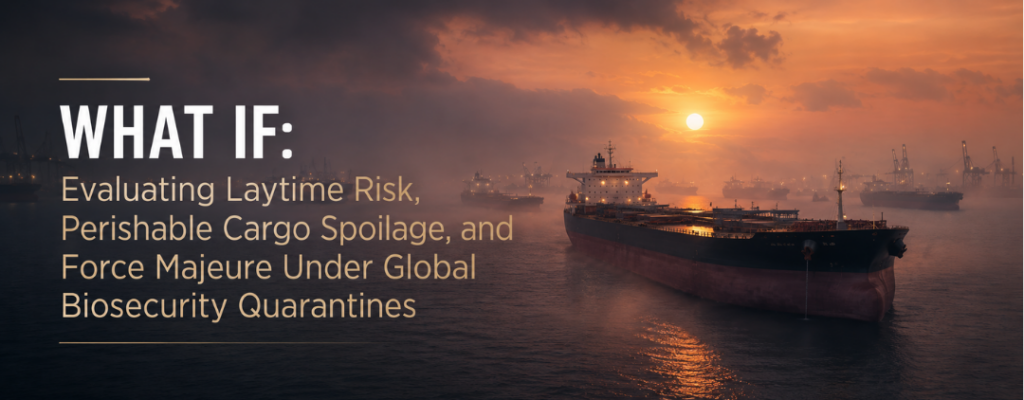
In international dry bulk logistics, we are hyper-aware of geopolitical choke points and weather disruptions. We write extensive contingency plans for a canal closure or a seasonal port strike. However, the most volatile vulnerability in global agriculture logistics isn’t a missile or a storm—it is a microscopic biological entity.
In the bulk grain desk, operations managers live in constant fear of phytosanitary rejections. A single weevil found in a cargo hold beam or a minor trace of unauthorized fungal spores can completely halt a 65,000-dwt Panamax vessel at a discharge port like Cairo or Qingdao, turning a smooth voyage into an immediate post-fixture nightmare.
Every year, millions of dollars are lost to minor quarantine delays. But at Marcenta, we like to stress-test the legal boundaries of global trade: What if a premier global grain export corridor—such as the US Gulf or Santos—was hit by an aggressive, newly mutated agricultural pest, triggering an instant, mandatory 90-day international phytosanitary quarantine on all departing vessels?
The resulting fallout wouldn’t just delay shipments; it would completely shatter the foundational contractual architecture of international commodity trading.
The 90-Day Biological Gridlock Framework:
┌────────────────────────────────────────────────────────┐
│            Instant 90-Day Mandatory Quarantine         │
└───────────────────────────┬────────────────────────────┘
                            │
             Where is the vessel trapped?
            ┌───────────────┴───────────────┐
            ▼                               ▼
    [ AT DISCHARGE PORT ]           [ AT LOADING PORT ]
  Who bears the waiting risk?     Does Laytime run while the
  Is the vessel off-hire?         cargo is legally blocked?
            │                               │
            └───────────────┬───────────────┘
                            ▼
 [ Legal Conflict: Demurrage vs. Force Majeure vs. Frustration ]
1. The Total Collapse of Laytime and Demurrage Mechanisms
Under standard English Maritime Law, once a valid Notice of Readiness (NOR) is served, the laytime clock starts ticking. If a quarantine is imposed before arrival at the berth, the battle over whether the vessel is legally an “arrived ship” begins.
In our 90-day quarantine scenario, if a vessel is locked out by port health authorities at the outer anchorage, standard Charter Party (CP) clauses like the “Quarantine Clause” would be pushed past their breaking points.
- Owners would argue that the delay is a port constraint and that the time counts as laytime or demurrage under the rule of “Once on demurrage, always on demurrage.”
- Charterers would aggressively point to standard exceptions clauses, claiming that a sovereign biological quarantine acts as a complete pause on liability.
With a 90-day standstill, a standard demurrage rate of $25,000 per day would accumulate a staggering $2.25 million bill per vessel before a single hatch is opened. No chartering desk can absorb that volume of exposure without facing instant insolvency.
2. The Force Majeure and Frustration Standoff
Commodity trading giants would instantly look to activate their Force Majeure clauses under GAFTA or FOSFA rules to cancel or suspend execution of their sales contracts. However, under English commercial law, proving that a biological quarantine completely “frustrates” a contract is a notoriously high legal mountain to climb.
Because grain is a perishable commodity, a 90-day delay inside an enclosed steel cargo hold moving through tropical zones would trigger catastrophic self-heating and spoilage. The cargo would literally rot before the legal teams could agree on an arbitrator. The dispute would rapidly pivot from a simple delay argument into a multi-billion-dollar cargo destruction battle between P&I Clubs and cargo underwriters.
How Marcenta Builds Biological Resilience into Your Print
The sarcastic truth of the modern grain desk is that operators sign off on generic, copy-pasted quarantine clauses because they assume a port health delay will never last more than 3 or 4 days.
At Marcenta, when we live by our core motto, Where cargo meets the right vessel, we bring forensic risk mitigation to the drafting phase. We protect our commodity traders, charterers, and owners by carving out precise, clear-cut Biosecurity Allocation Clauses.
We ensure that if an extraordinary sovereign quarantine hits, the financial risk is balanced transparently between laytime counts and off-hire parameters, preventing a biological incident from turning into a total financial wipeout. We don’t just secure space; we safeguard your capital from the unexpected friction of global trade.
To evaluate our current, highly vetted bulk positions and explore bulletproof cargo options with fully optimized risk clauses, visit our live Market Insight & Activity desk.
For the baseline international regulations governing agricultural transport security and grain quality standards, reference the latest code revisions on the International Plant Protection Convention (IPPC).
#ShipWithMarcenta