The Illusion of ‘Good Weather’ in Speed & Consumption Claims: The Undersea Chess
Chartering & Contracts, Chartering Insights, Chartering Knowledge, Dry Bulk Insights, Dry Bulk Shipping, Drybulk, English Law, Maritime Law, Operational Risk, Risk Management in Trade, Ship Chartering, Ship Performance, Time Charter #ShipWithMarcenta, BIMCO Clauses, Bunker Consumption, Charter Party, Deck Logbook, Dry Bulk Shipping, English Maritime Law, Good Weather Clause, Maritime Arbitration, OceanRoute, Operational Risk, Performance Warranty, Ship Performance, Shipbroking, Speed And Consumption Claims, time charter, Voyage Performance, Weather Routing, Weathernews, WNI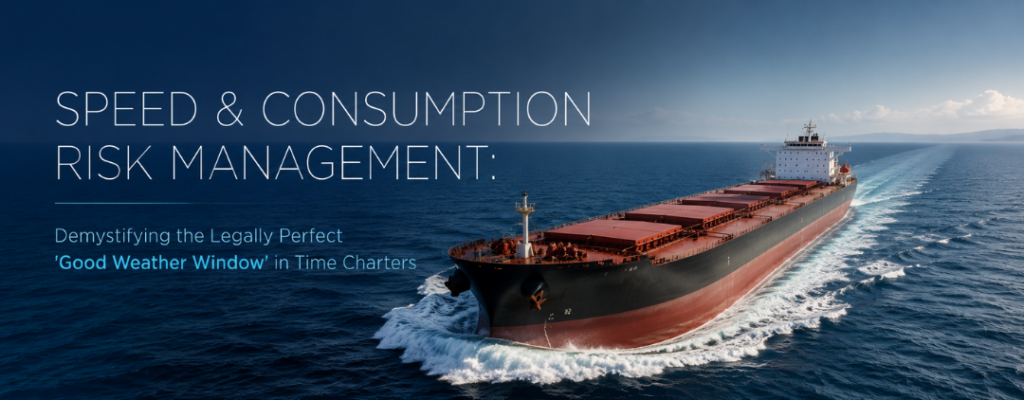
In international Time Charter (T/C) negotiations, few areas trigger as much high-stakes friction during post-fixture auditing as a vessel’s performance. When an Owner warrants that a vessel can maintain a specific speed on a specific bunker consumption, a multi-million-dollar financial guarantee is signed.
To protect this guarantee, the contract almost always limits the performance warranty strictly to periods of “Good Weather.”
To an outsider, or to a chartering assistant glancing quickly at a weather app, “good weather” sounds like a straightforward, intuitive concept: clear skies, no major storms, and smooth sailing.
However, under English Maritime Law, “Good Weather” is not a meteorological vibe; it is a pedantic, highly restricted legal fortress. And if your operations desk treats it casually during a performance dispute, you can easily watch a $75,000 under-performance claim melt into thin air before the London maritime arbitrators.
The Technical Reality: The Anomaly of the ‘Good Weather Window’
Under standard English law precedents (such as the The Didymi [1988] and The Gas Enterprise [1993]), a vessel’s speed and fuel performance cannot be judged across the entire span of a 20-day ocean transit. Instead, experts must slice the voyage into tiny, highly specific pockets called “Good Weather Windows.”
For a day to legally qualify as “Good Weather,” it must simultaneously meet all of the following micro-parameters established in the Charter Party rider clauses:
- Wind Speed Limits: Strictly bounded by the Beaufort Scale (usually Beaufort Scale 4 or lower).
- Sea State Restrictions: Strictly bounded by the Douglas Sea State (usually DSS 3 or lower, meaning maximum significant wave heights of 1.25 meters).
- The No Adverse Swell Catch: Even if the wind is dead calm and the local sea waves are flat, if a long-period, heavy adverse swell is coming from a distant storm across the Pacific and slowing the ship’s hull down, that day is legally disqualified from the performance calculation.
The Performance Warranty Audit Flowchart:
┌────────────────────────────────────────────────────────┐
│               24-Hour Voyage Log Segment               │
└───────────────────────────┬────────────────────────────┘
                            │
            Does it meet ALL CP weather specs?
            (Beaufort ≤4, DSS ≤3, No Adverse Swell)
            ┌───────────────┴───────────────┐
            ▼                               ▼
       [ YES ]                           [ NO ]
  Legally a "Good Weather Day"      Disqualified from Sample.
  Vessel's performance counted.     Owner runs zero risk for
                                    under-performance on this day.
The Sarcastic Chess: Logbooks vs. Commercial Weather Routing
The real battle begins when the sample size shrinks. If a vessel executes a 15-day voyage across the Atlantic, but faces minor swells or moderate winds for 13 of those days, you are left with only 2 days of pure “Good Weather.” Under English law, the vessel’s performance over those 2 days is extrapolated to judge her performance for the entire 15-day trip!
This triggers the ultimate data showdown:
- The Owner’s Shield: Points proudly to the Master’s handwritten Deck Logbooks, which coincidentally note a constant “Beaufort 5 or adverse swell” for almost every day of the voyage, disqualifying the claims.
- The Charterer’s Sword: Points to independent, satellite-backed Commercial Weather Routing Reports (like OceanRoute, Weathernews, or WNI), which claim the weather was a perfect Beaufort 3.
Under English arbitration trends, while commercial satellite data is heavily weighted, the Deck Logbook remains a primary legal document. Unless the Charterer can prove the Master actively falsified the logs (a very high legal bar to cross), the Master’s weather notes often prevail, turning a blatant under-performance into a legally unchallengeable voyage.
How Marcenta De-Risks the Performance Clause
The irony of modern time chartering is that desks accept generic “Good Weather” definitions because they are focused on negotiating the headline hire rate, leaving the performance clauses completely unvetted.
At Marcenta, when we enforce our guiding philosophy of Where cargo meets the right vessel, we run a pre-emptive audit on the Speed & Consumption text. We ensure our Charterer and forwarder clients aren’t backed into a corner by vague swell definitions, and we fight to insert clauses that mandate the use of specific, binding independent weather routing data as the ultimate arbiter, eliminating the logbook stalemate entirely. We bring clinical, forensic precision to your contract terms so your time-charter margins are never eroded by hidden currents.
To view our current list of operationally elite, fully performance-vetted tonnage options for your upcoming T/C windows, explore our live Market Insight & Activity portal.
For the exact standardized contractual language regulating performance warranties and maritime transit measurements, consult the official BIMCO Speed and Consumption Clause Guidelines.
#ShipWithMarcenta