
Dry bulk index drops hard, but not everywhere at once
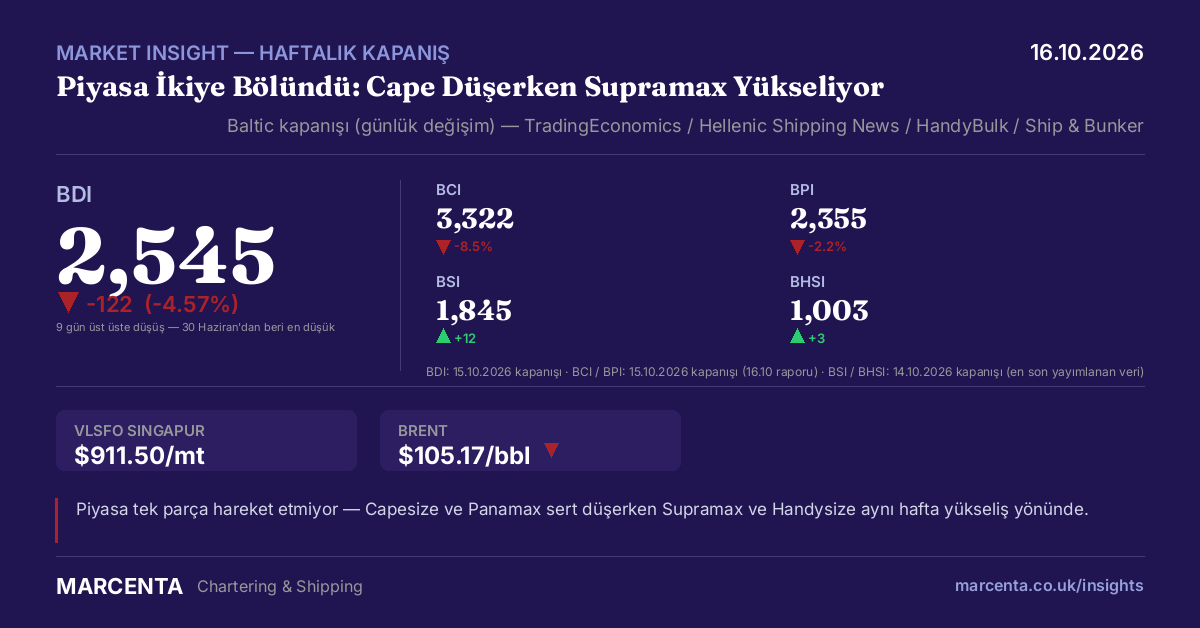
The Baltic Dry Index fell to 2,545 points on Thursday, a 4.6% daily drop and the ninth consecutive session in the red. That's the lowest reading since June 30 (TradingEconomics, 15 October close; cross-checked against Hellenic Shipping News, 16 October). On its own, that number reads like a broad market retreat. It isn't quite that.
Almost all of the pain is in the big ships. The Capesize index has fallen from 4,512 at the start of this week (October 8) to roughly 3,322 by Thursday's close, a drop of about 26% in five sessions, with 8.5% of that coming in a single day (Hellenic Shipping News, 16 October). Panamax followed, down around 2.2% daily. Both segments carry the iron ore and coal trades, and the demand side has been soft: Vale's Brazilian iron ore exports are down 7% year on year, and Rio Tinto's higher Pilbara output hasn't fully offset that gap. Black Sea steel loadings were also down 65.6% year on year in the third quarter, with carriers citing shipping risk in the region (Hellenic Shipping News, 15 October).
Meanwhile Supramax and Handysize, which carry more grain and general cargo, moved the other way. The Supramax index sat at 1,845 on October 14, up 12 points on the week, and Handysize at 1,003, up 3 (handybulk.com). So this week's story isn't a dry bulk downturn. It's a split: large-ship, bulk-commodity rates falling fast while the smaller, more diversified segments hold or gain.
Our own fixtures this week back that reading. We covered Panamax tonnage at $35,000-38,500/day, a Kamsarmax grain run at $24,500/day, and an Ultramax steel slabs fixture at $32,000/day, none of which show the kind of swing the index implies. The paper and FFA market tends to move ahead of physical fixtures in weeks like this, and that gap is worth watching rather than reacting to.
Separately, Brent crude sits at $105.17 a barrel, up on the week on renewed tension in the Middle East (TradingEconomics, 16 October). Bunker costs are a factor worth tracking into next week, particularly for Capesize owners already absorbing lower freight.