
Capesize Drags the Index Down, Grain Lanes Don’t Follow: Weekly Close, 9 October 2026
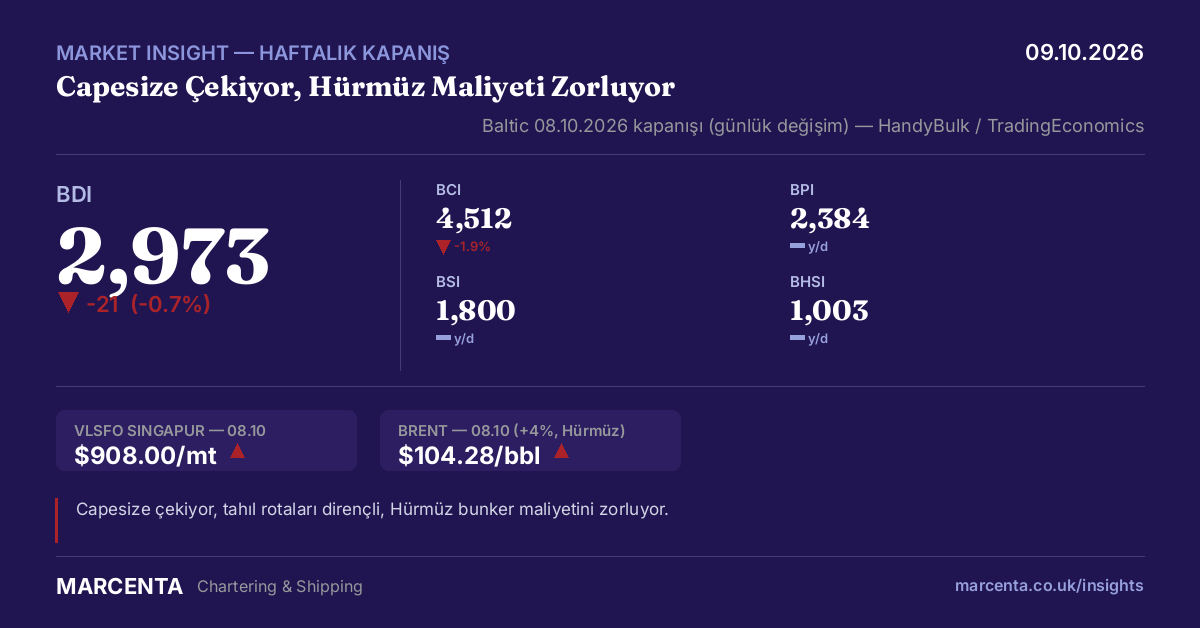
The BDI dropped for four consecutive sessions, closing at 2,973 on 08.10, its lowest print since late August (handybulk.com). Look past the headline number though, and the picture splits. The entire decline is coming from Capesize: the BCI fell from 4,638 on 06.10 to 4,512 on 08.10, down roughly 1.9% day on day, with average TCE slipping toward the $37,400/day mark. Panamax and Supramax held broadly flat over the same week, with Supramax even ticking slightly positive.
One detail stands out. The C3 (Tubarão-Qingdao) and C5 (Western Australia-China) routes have not moved on handybulk.com since 06.10: C3 at $37.65/mt, C5 at $14,425/mt, BCI 5TC at $2,796, unchanged for four days straight. That doesn't mean the market has frozen, it means no fresh fixtures are being reported on those particular routes. The real Capesize weakness is likely building elsewhere, outside the main-line trades.
Our own fixture data tells a different story for the mid-size segment, one the headline indices don't fully capture. Per Doric's weekly report dated 02.10, Supramax tonnage fixed Baltimore/St Lawrence-Lagos grain at $32,000/day TC and Veracruz-Singapore/Japan grain at $33,000/day TC. The broader Supramax TC average sat around $22,714/day at end-September. That's a meaningful gap: grain export lanes are pulling noticeably stronger demand than the segment average suggests. Hellenic Shipping News's coal data points the same way, seaborne coal volumes were down 6.7% year on year in September, dragged by thermal coal, while metallurgical coal partly offset the slide and Japan kept importing on the back of elevated LNG prices.
The risk worth watching sits elsewhere entirely. Nine tankers have been attacked in the Strait of Hormuz over the past week, with transits running roughly 30% below normal at around 9.5 million b/d weekly. Brent jumped to $104.28 on 08.10, up 4% in a single session. The regional risk has already hit bunker pricing: Fujairah VLSFO at $988/mt and MGO at $1,716/mt now sit above both Singapore ($908) and Rotterdam ($728), the most expensive of the three major hubs. None of this has visibly fed through to dry bulk freight levels yet, but with Capesize already soft, the added bunker cost is setting up to squeeze owner margins from two directions at once. Two separate stories for now, landing in the same week.
Sources: handybulk.com (BDI, BCI, C3, C5, BPI, BSI), TradingEconomics and Hellenic Shipping News (08.10 market commentary, coal data), shipandbunker.com (Fujairah/Singapore/Rotterdam bunker prices), Marcenta's own fixture records (Doric Weekly Insight, 02.10.2026).