
Bunker Catches Up With a Cape-Led Rally
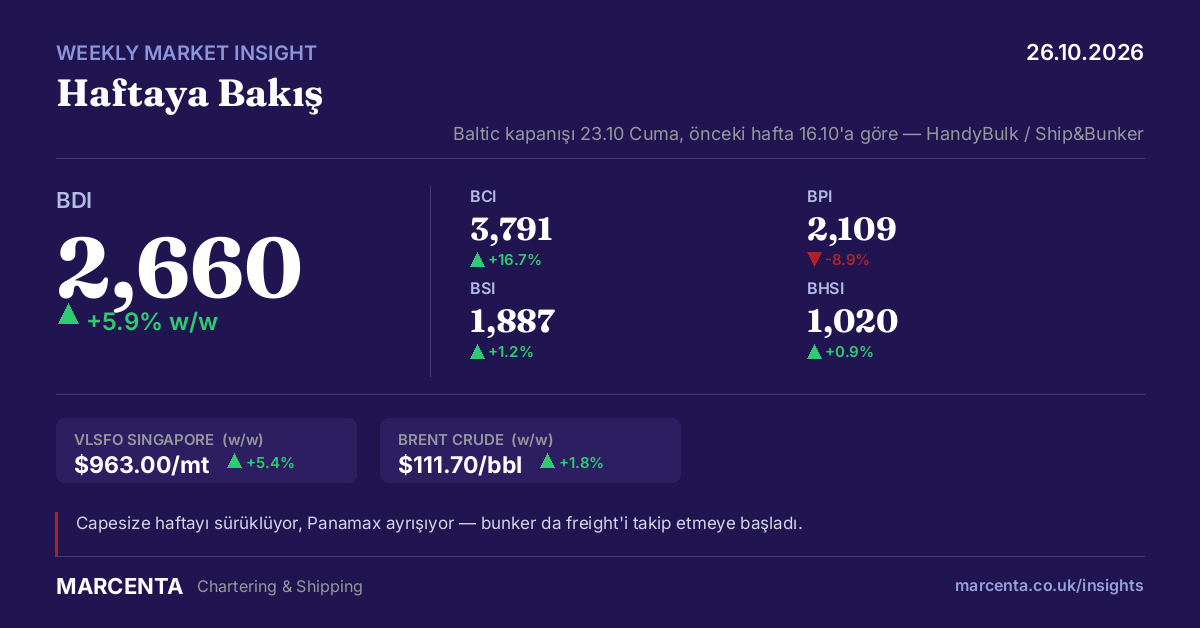
Baltic Exchange data via Hellenic Shipping News and Baird Maritime, Ship & Bunker, Trading Economics. Week of 19-23 October 2026.
VLSFO in Singapore closed Friday at $963/mt, up 5.4% on the week. It didn't move in one jump; from Monday to Friday it climbed on nearly every trading day, according to shipandbunker.com. That's worth flagging on its own, because the same week produced a freight market that looked, on the surface, like a clear win for owners. The Baltic Dry Index rose 5.9% to 2,660, the Capesize index climbed 16.7% to 3,791, and the 5TC average moved up to $34,380/day from $29,464. Panamax went the other way, down 8.9% to 2,109, while Supramax and Handysize barely moved.
Put the two together and the Capesize gain looks smaller than the headline number suggests. A 16.7% rate increase that lands in the same week as a 5.4% rise in the main fuel grade isn't pure upside; some of what owners picked up on freight gets handed back at the bunker tank. Brent didn't help either, swinging from $108.82 on Monday to $113.17 on Thursday before settling at $111.70. C3 and C5 both firmed too, C3 to $34.25/mt and C5 to $14.20/mt, so the Capesize trade is still paying more. It's just that a bigger share of the increase is going straight into the tank.
The Panamax weakness has a port-side layer as well. Our own AIS data shows Panamax and Kamsarmax vessels waiting a median of close to 10 hours to berth at Newcastle, against roughly 1.7 hours back in September, while every other size class at that port improved over the same stretch. We flagged this earlier in the week. The question for the days ahead is whether it eases or hardens into something that keeps weighing on the Panamax index.
Four things worth watching this week: whether the Newcastle queue starts clearing, whether the Pacific typhoon disruption that helped lift Capesize rates fades or keeps feeding the rally, whether China's iron ore stockpile build, up to 148.3 million tonnes according to Hellenic Shipping News, keeps pulling Capesize demand with it, and what a Brent price holding above $110 does to bunker costs, and in turn to break-evens, on longer voyages.