
The Fleet That Couldn’t Move for 8 Years: The Forgotten Lesson of the Yellow Fleet
Maritime History, News & Insights Fleet Management, Maritime History, Shipbroking, Shipping Strategy, Suez Canal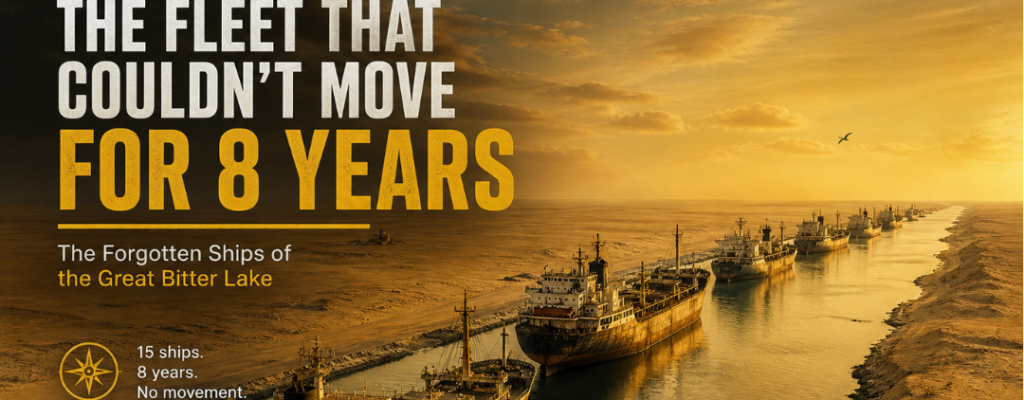
In shipping, location is often treated as an advantage.
But history shows that location without mobility can become a liability.
One of the most striking examples occurred in 1967—
when a group of vessels entered the Suez Canal and never left.
What Happened?
During the Six-Day War in 1967, the Suez Canal was abruptly closed.
Ships already transiting the canal were unable to exit.
Fifteen vessels became trapped in the Great Bitter Lake—
a widening section of the canal system.
They would remain there for the next eight years.
Who Were They?
The stranded vessels came from different nations:
- United Kingdom
- Germany
- Poland
- Sweden
- France
- United States
Despite geopolitical tensions on land, the crews at sea created an unexpected reality.
They became a shared, isolated maritime community.
Where Did They Stay?
All vessels were anchored in the Great Bitter Lake—
effectively forming a stationary fleet.
Over time, desert sand coated the ships, giving them a distinct appearance.
They became known as:
The Yellow Fleet
When Did It End?
The canal remained closed until 1975.
For nearly a decade:
- Ships could not move
- Trade routes were disrupted
- Strategic positioning lost its meaning
Why Didn’t They Leave?
There was no alternative route.
No operational workaround.
No repositioning option.
The constraint was absolute.
How Did They Survive?
Despite the isolation, crews adapted:
- Maintenance was shared
- Supplies were coordinated
- Communication networks were formed
They even organized social activities, including inter-ship competitions.
But operationally—
they remained inactive assets.
The Hidden Strategic Lesson
The Yellow Fleet is not just a historical anomaly.
It is a strategic case study.
In shipping:
Position without mobility is exposure.
It does not matter how well-positioned a vessel is—
if it cannot respond to market movement.
Modern Application in Shipping
Similar structural disruptions and their long-term impact on global trade are analysed in reports such as the UNCTAD Maritime Transport Review.
Today’s market is more complex, but the principle remains unchanged.
Operators face constraints such as:
- Congested ports
- Political restrictions
- Canal disruptions
- Regional imbalances
In such conditions:
- A well-placed vessel can become idle
- A delayed decision can remove optionality
- A missed repositioning window can define profitability
The Real Risk
The biggest risk in shipping is not always being in the wrong place.
It is being unable to leave it.
Practical Insight
Operational flexibility and risk management remain key themes across the industry, as also highlighted by the International Chamber of Shipping.
Experienced brokers and operators focus on:
- Maintaining flexibility
- Preserving repositioning options
- Acting before constraints become absolute
Because once movement is lost—
control is lost with it.
For real-time vessel positioning and cargo flow visibility, visit our Market Insight page.
Final Thought
The Yellow Fleet waited for the canal to reopen.
The market did not wait for them.
In shipping:
Mobility is not a detail.
It is the difference between opportunity and exposure.