When a “Valid” NOR Fails: The Hidden Limits of WIPON, WIBON and WCCON
Case Analysis, Case Studies, Chartering Insights, Maritime Law Charter Party, Demurrage, Laytime, NOR, Shipping Law, WIBON, WIPON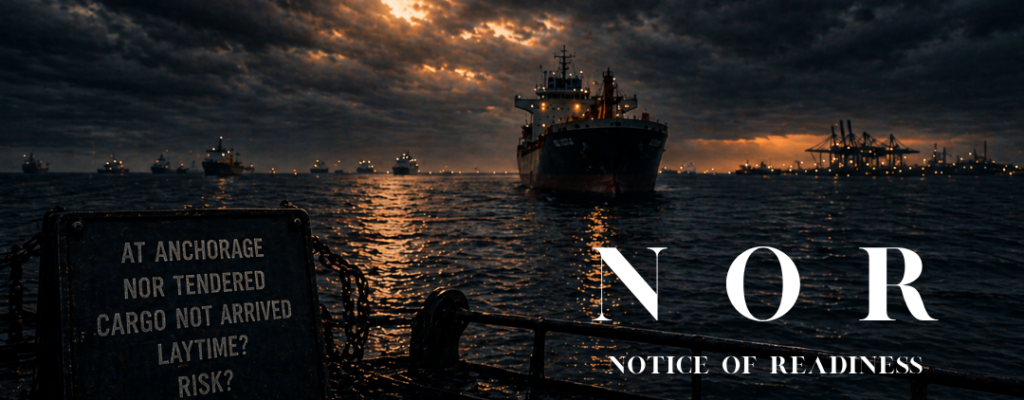
In chartering, certain clauses are assumed to “solve” operational constraints.
WIPON.
WIBON.
WCCON.
Together, they are often treated as a complete protection package for owners.
But there are scenarios where even a Notice of Readiness (NOR) — tendered correctly and accepted without reservation — can still fail to trigger laytime.
The Scenario
A vessel arrives within laycan.
- Port is congested
- No berth available
- Vessel waits at anchorage
The charter party includes:
- WIPON (Whether In Port Or Not)
- WIBON (Whether In Berth Or Not)
- WCCON (Whether Customs Cleared Or Not)
The Master tenders NOR at anchorage.
Charterers accept.
On the surface:
Everything appears valid.
The Missing Element
Cargo is not yet in the port.
Expected arrival:
48–72 hours later.
No trucks.
No barges.
No loading sequence prepared.
The vessel is ready.
The cargo is not.
The Core Question
Can NOR be valid when cargo is not physically available to load?
The Legal Friction
Two positions emerge:
Owner’s view:
- Vessel is an arrived ship
- NOR properly tendered
- Charter clauses cover location constraints
→ Laytime should start
Charterer’s view:
- Cargo is not ready
- No immediate ability to load
→ NOR should not be effective
What WIPON / WIBON Actually Do
These clauses address location and access constraints:
- WIPON → removes requirement to be physically inside port
- WIBON → removes requirement to be alongside
- WCCON → removes customs clearance barriers
They solve where the vessel can tender NOR.
They do not automatically solve whether loading can begin.
These clauses are typically derived from standard charter party wording and industry practices such as those published by BIMCO standard contracts and clauses.
Readiness: Physical vs Contractual
This is where the distinction becomes critical:
- Contractual readiness → vessel meets formal requirements
- Physical readiness → cargo operations can commence immediately
In many disputes, these two are not aligned.
The Acceptance Trap
A key complication:
NOR is accepted.
Does acceptance validate it?
Not necessarily.
Acceptance without reservation may strengthen the owner’s position—
but it does not automatically cure a fundamental lack of readiness.
The Risk Allocation Problem
Systemic inefficiencies and delays in global shipping operations are regularly analysed in reports such as the UNCTAD Maritime Transport Review.
If NOR is treated as valid:
- Laytime begins
- Demurrage exposure builds
If NOR is treated as invalid:
- Owners absorb idle time
- Commercial positioning is lost
The difference is not theoretical.
It is financial.
What Most Practitioners Miss
WIPON / WIBON / WCCON are often overestimated.
They expand where NOR can be tendered.
They do not eliminate the requirement that cargo must be ready in a practical, operational sense.
Practical Insight
Operational readiness and port execution challenges are also reflected in broader industry guidance from the International Chamber of Shipping.
Before relying on these clauses, operators should assess:
- Cargo arrival timing
- Terminal readiness
- Loading logistics (trucks, barges, equipment)
- Known congestion patterns
Because once NOR is tendered, the dispute framework is already defined.
For real-time cargo flow and vessel positioning, you can also visit our Market Insight page.
Final Thought
In chartering, protection clauses create comfort.
But comfort is not coverage.
A NOR can be:
Formally valid.
Operationally accepted.
And still—
commercially ineffective.
Because in shipping:
Readiness is not only about the vessel.
It is about the system being ready to act.