
The Warships That Could Not Be Boarded: The Hidden Story of the Turtle Ships
Maritime History, Shipping Insights, Strategy Imjin War, Innovation, Maritime Strategy, Naval History, Shipping Strategy, Turtle Ships, Warships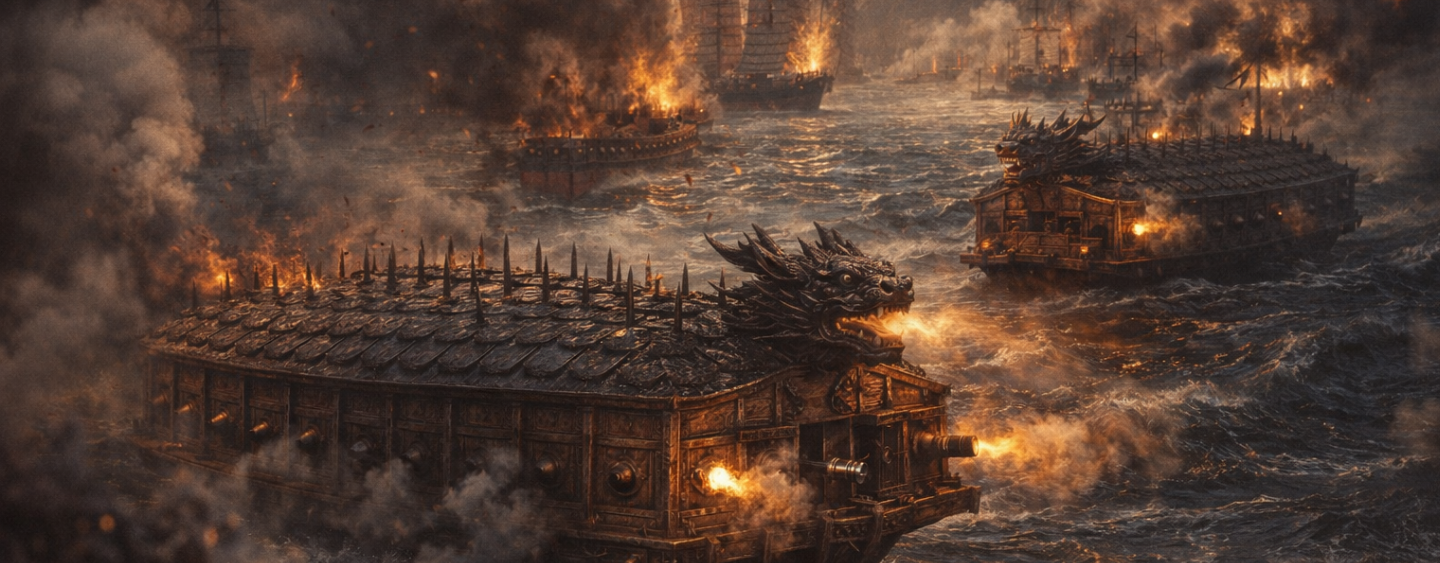
In naval history, dominance was often defined by size, firepower, or numbers.
But in the late 16th century, one innovation changed everything — not by being bigger, but by being smarter.
They were called “Turtle Ships”.
And for a brief moment in history, they made entire fleets powerless.
What Were Turtle Ships?
Turtle Ships (Geobukseon) were armoured warships developed by the Korean navy during the Imjin War (1592–1598).
At first glance, they resembled traditional ships.
But their design hid something revolutionary.
- Covered decks to prevent boarding
- Iron spikes on the roof
- Enclosed structure
- Multi-directional cannon placement
They were not built to impress.
They were built to eliminate the enemy’s advantage.
The Context: A Different Kind of Naval Warfare
At the time, Japanese naval tactics relied heavily on:
- Closing distance quickly
- Boarding enemy vessels
- Hand-to-hand combat
In other words:
Victory depended on contact.
Turtle Ships removed that possibility entirely.
The Strategic Breakthrough
By preventing boarding, Turtle Ships forced a complete shift in combat dynamics.
Instead of close combat:
- Engagements became distance-based
- Cannons became decisive
- Manoeuvrability replaced brute force
This was not just a new ship.
It was a new way of fighting.
Why It Worked
The brilliance of Turtle Ships was not in technology alone.
It was in understanding the opponent.
They were designed specifically to counter:
- Boarding tactics
- Close-range engagements
- Fleet clustering
They turned the enemy’s strength into a weakness.
The Hidden Lesson for Modern Shipping
While Turtle Ships belong to naval warfare, their strategic principle remains relevant:
Success is not always about being stronger.
It is about removing the opponent’s advantage.
In commercial shipping, this translates into:
- Positioning instead of chasing
- Timing instead of reacting
- Structure instead of improvisation
The Overlooked Insight
Most people study outcomes.
Few study the structure behind them.
Turtle Ships did not win because they were powerful.
They won because they changed the rules.
Final Thought
In shipping, as in strategy, the real advantage is rarely visible at first.
It lies in:
Understanding the system — and quietly reshaping it.