The Convoy That Sailed Without Lights: When Visibility Became a Liability
Chartering Strategy, Maritime History, Shipping Insights, Strategy Freight Market, Logistics, Maritime History, Naval History, Risk Management, Shipbroking, Shipping Strategy, Trade Strategy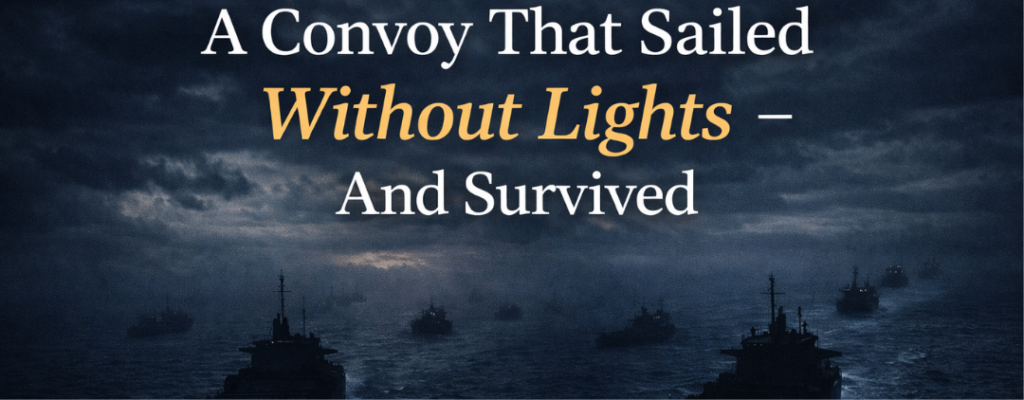
In most industries, visibility is considered an advantage.
In shipping, it often is.
But history shows that under certain conditions, visibility can become the greatest vulnerability.
In 1942, during one of the most dangerous periods of maritime history, a convoy crossed the Atlantic under a radically different principle:
They chose not to be seen.
The Context: A War of Detection
During World War II, Allied shipping routes were under constant threat from German U-boats.
These submarines relied heavily on detection capabilities, including:
- Visual identification of ships at night
- Radio signal interception
- Predictable convoy formations
For merchant vessels, being seen often meant being targeted.
The system favoured the observer.
The Strategic Shift
Rather than attempting to outgun or outrun the threat, one convoy adopted a different approach:
They removed their visibility entirely.
The measures were extreme:
- No navigation lights
- Strict radio silence
- Minimal signalling between vessels
- Reduced formation visibility
Each vessel effectively operated in isolation — within a group.
Such operational decisions, particularly under constrained communication and coordination conditions, reflect principles still relevant in modern shipping, as highlighted by the International Chamber of Shipping.
The Risk Trade-Off
This strategy introduced a different kind of danger:
- Increased risk of collision
- Navigation uncertainty
- Loss of coordinated manoeuvrability
In essence, the convoy replaced external risk with internal risk.
This was not risk elimination.
It was risk selection.
The Outcome
Despite the challenges, the convoy successfully crossed with minimal losses.
The reason was not superior strength.
It was the absence of detection.
The enemy could not effectively attack what it could not locate.
The Strategic Principle
This historical case reveals a powerful and often overlooked principle:
Advantage does not always come from improving your position.
Sometimes, it comes from removing your opponent’s advantage.
In this case:
- The U-boats depended on visibility
- The convoy eliminated visibility
The result was asymmetry.
This type of strategic asymmetry continues to influence global trade dynamics, as discussed in the UNCTAD Maritime Transport Reports.
Modern Application in Shipping
While today’s shipping environment is vastly different, the underlying logic remains relevant.
In commercial shipping:
- Not all cargo positions should be widely circulated
- Not all vessel availability should be fully exposed
- Not all negotiations benefit from transparency
Excessive visibility can lead to:
- Market pressure on rates
- Loss of negotiating leverage
- Increased competition on the same position
Modern commercial practices and information control in chartering are often structured around widely used industry frameworks such as the BIMCO charter party clauses.
Controlled Visibility as a Strategy
Experienced operators understand that:
Information is not just operational.
It is strategic.
The question is not simply:
“What do we know?”
But:
“What do we choose to reveal?”
This is particularly relevant in:
- Competitive cargo markets
- Tight tonnage environments
- Sensitive negotiation phases
Practical Insight
The most effective brokers and operators do not always show the full picture.
They manage information flow.
They control timing.
They decide when visibility adds value — and when it reduces it.
Final Thought
The convoy that sailed without lights did not remove risk.
It chose the right risk.
In modern shipping, the same logic applies.
Visibility is powerful.
But only when used deliberately.
Because sometimes, the strongest position is the one that is not fully seen.
You can also explore how this principle applies in live markets via our Market Insight page.