Case Study: When a “Perfect” Fixture Carries Hidden Risk
Case Studies, Chartering Strategy, Shipping Insights Black Sea Shipping, Case Study, Chartering Risk, Freight Market, Laycan, Logistics, Maritime Operations, Shipbroking, Shipping Strategy, Vessel Positioning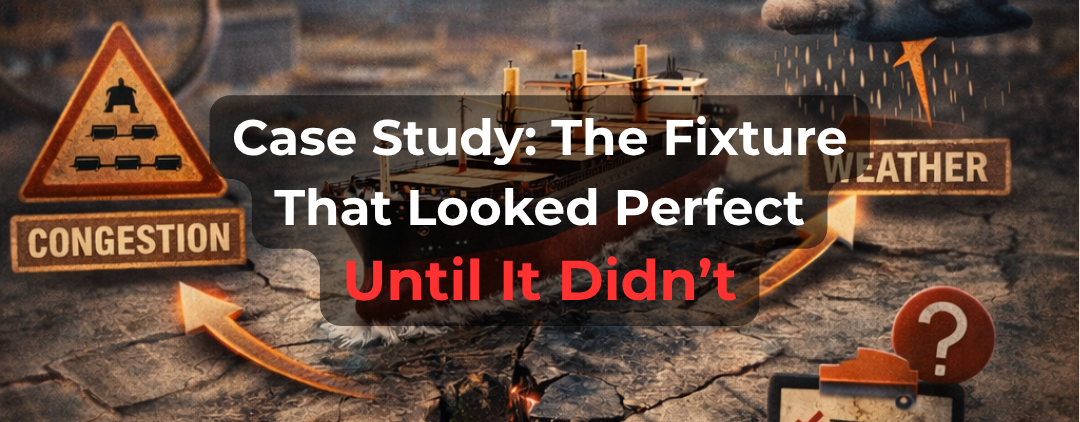
In chartering, not all risks are visible at first glance.
Some fixtures look commercially attractive, operationally feasible, and perfectly timed.
Until they are not.
This case study explores a common scenario in the Black Sea market — where a vessel appears to meet laycan requirements, but underlying variables introduce significant execution risk.
The Scenario
You are fixing a 32,000 DWT handy vessel under the following conditions:
Vessel Position
- Open: Constanta
- Estimated Time of Arrival (ETA): 12 March
- Previous cargo: Grain
- Speed/consumption: Standard market levels
Cargo Details
- Quantity: 30,000 MT steel products
- Load Port: Odessa
- Discharge Port: Italy
Laycan
- 14–16 March
Market Conditions
- Freight market firming
- Limited prompt tonnage available
At first glance, the vessel appears well-positioned to meet the laycan and secure the fixture.
The Hidden Variables
However, several operational risks are not immediately visible:
1. Increasing Black Sea Congestion
Port congestion levels are rising, particularly in key loading areas.
This directly affects berth availability and loading schedules.
2. Weather Constraints
Weather forecasts indicate tightening conditions, potentially impacting both sailing time and port operations.
3. Port Operational Uncertainty
Odessa port operations are not fully predictable, with fluctuating loading efficiency.
4. Previous Voyage Delays
The vessel’s prior employment included minor delays, which may impact its true readiness.
The Core Question
The vessel can technically meet laycan.
But only under ideal conditions.
No delays.
No congestion impact.
No weather disruption.
In practical terms, this creates a narrow execution margin.
Commercial Decision Options
You are faced with three strategic choices:
Option A: Fix at a Strong Rate (Tight Laycan)
- Advantage: Secures the cargo at a favourable rate
- Risk: High probability of missing laycan if conditions deteriorate
Option B: Negotiate for Wider Laycan
- Advantage: Reduces execution risk
- Risk: Charterer may withdraw or fix alternative tonnage
Option C: Pass the Opportunity
- Advantage: Preserves vessel positioning and avoids exposure
- Risk: Missed revenue and market opportunity
Strategic Insight: The Margin of Error
The key issue is not whether the vessel can meet laycan.
It is how much margin exists if conditions worsen.
In shipping, risks rarely occur in isolation.
They compound.
A minor delay, combined with congestion and weather disruption, can quickly escalate into a missed laycan and a lost fixture.
Practical Takeaway
Experienced operators evaluate:
- Buffer time vs laycan window
- Reliability of voyage estimates
- External risk factors (port, weather, congestion)
- Market alternatives
A technically feasible fixture is not always a commercially sound decision.
Final Thought
In chartering, the difference between a successful fixture and a failed one often comes down to a few hours.
And more importantly:
How realistic your assumptions are when everything does not go as planned.