
What If the Bridge Didn’t Close? A Study in Maritime Decision Timing
Case Analysis, Case Studies, Chartering Strategy, Maritime Analysis, Navigation & Safety, Shipping Strategy, Strategy, What If Series Decision Making, Maritime Risk, Operational Strategy, Ship Navigation, Shipping Safety, What if Series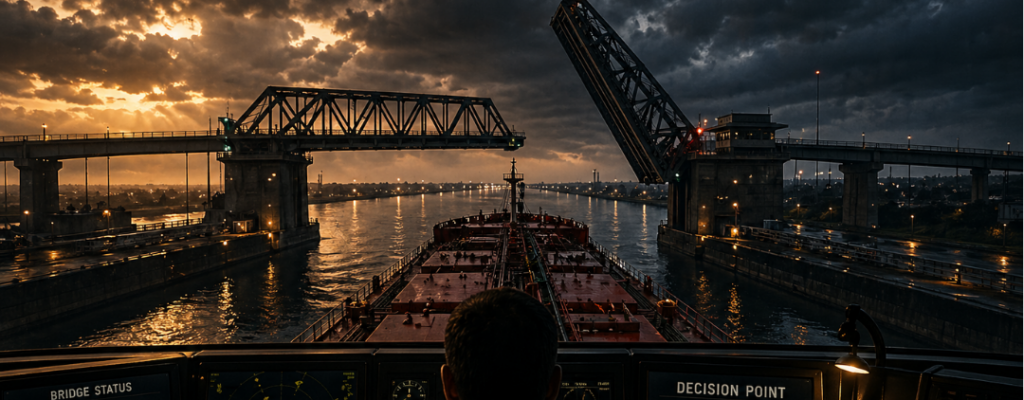
In maritime operations, incidents rarely begin at the point of impact.
They begin much earlier.
Often at a moment that seems insignificant at the time.
A delay.
A hesitation.
A decision to continue.
The Scenario
A fully loaded vessel approaches a restricted passage.
The conditions are typical for a controlled transit:
- Limited maneuvering space
- External forces such as current or wind
- A predefined timing window
Ahead lies a movable bridge, scheduled to close in coordination with the vessel’s arrival.
The transit is planned.
The execution seems routine.
The Deviation
The bridge does not close on time.
The delay is minimal.
Measured in minutes.
No alarms are triggered.
No immediate danger is apparent.
But something changes.
The Commitment Point
At this stage, the vessel is already:
- Aligned with the approach
- Maintaining forward speed
- Operating within a narrowing margin of flexibility
The decision must be made:
Continue or abort?
The Critical Decision
Instead of reassessing, the vessel continues.
Why?
Because:
- Momentum has already been built
- Stopping distance is underestimated
- Turning options are limited
- The situation still appears manageable
This is the critical moment.
Not because something failed.
But because a decision was locked in.
The Outcome
A minor delay evolves into a major operational problem.
Not due to lack of information.
But due to delayed reaction.
The Hidden Mechanism
This scenario highlights a recurring pattern in maritime incidents:
The escalation does not come from a single failure.
It comes from commitment.
Once a vessel passes a certain point:
- Options reduce
- Reversibility decreases
- Risk increases exponentially
What If?
What if the vessel had:
- Reduced speed earlier?
- Held position outside the approach?
- Re-evaluated instead of continuing?
The outcome could have been entirely different.
Decision Timing in Maritime Operations
Principles around safe navigation and decision-making under operational pressure are also reflected in guidance provided by the International Chamber of Shipping.
In shipping, timing is not only about arrival.
It is about decision timing.
The most important decisions are often made before the situation becomes critical.
Practical Insight
Experienced operators understand that:
Operational decision-making is also influenced by contractual responsibilities and voyage planning frameworks, as reflected in BIMCO industry standards.
The most dangerous moment is not when something goes wrong.
It is when there is still time to change—
but the decision to change is delayed.
Risk Perspective
This applies across all areas of shipping:
- Navigation
- Chartering decisions
- Cargo commitments
- Voyage planning
In each case:
Broader patterns in operational risk and maritime incidents are often linked to systemic decision-making challenges discussed in the UNCTAD Maritime Transport Reports.
Early adjustment reduces risk.
Late adjustment amplifies it.
For real-time positioning, cargo flow, and market activity insights, you can also visit our Market Insight page.
Final Thought
Incidents are rarely the result of a single event.
They are the result of a sequence.
And within that sequence:
One decision matters more than the rest.
The decision to continue—
when stopping was still possible.