Broker’s Notebook: The Coos Bay Log Standoff and Emergency Draft Mitigation
Broker's Notebook, Cargo Claims, Dry Bulk Insights, Dry Bulk Shipping, Industrial Bulk Cargoes, Marine Claims, Technical Claims, Vessel Gear & Claims Broken Stowage Risk, Broker's Notebook, Coos Bay Log Standoff, Deadfreight Claim, Draft Mitigation, FIOS Clauses, Geared Handysize, Log Scaling, Marcenta Advisory, Maritime Arbitration, Port Authority Clearance, Post-Fixture Forensics, River Bar Constraints, Stowage Factor, Timber Cargo Dispute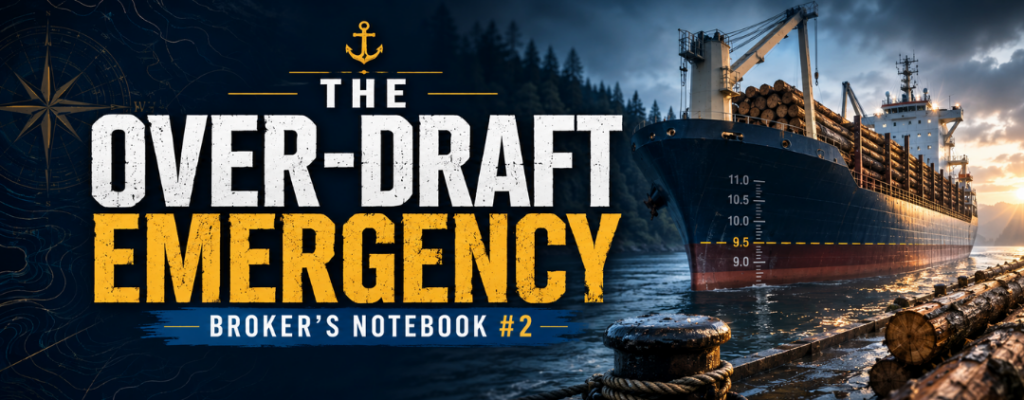
If you evaluate the commercial stability of a dry bulk voyage solely through the lens of deadweight tonnage scales or basic port-to-port routing, you remain fundamentally vulnerable to physical cargo mechanics. In international shipbroking, there is an elite subset of commodities that completely disregards theoretical paperwork. Chief among these is the volatile, high-friction world of Forest Products and Log Chartering.
When dealing with raw timber and log parcels moving out of high-volume loading hubs—such as Coos Bay, Oregon, or the US Pacific Northwest—the interaction between volatile volumetric metrics and local draft limits represents an immediate operational hazard. When an incorrect stowage factor calculation causes a geared vessel to breach its safe navigational draft before the cargo hold is physically filled, a routine spot voyage can instantly lock up in an expensive, high-stakes terminal standoff. To secure your fixtures against these hidden physical risks before your vessel arrives at the berth, you can review our active cargo metrics and see our active cargo & vessel openings updated daily.
The Incident: The Geared Handysize Trapped at the Pacific Bar
A few years ago, our desk was managing a modern 32,000 dwt geared Handysize vessel fixed to load a full cargo of fresh-cut softwood logs out of Coos Bay for discharge into a sensitive manufacturing terminal in the Far East. The charter party text featured standard, strict warranties regarding the vessel’s volumetric cubic capacity and a maximum permissible sailing draft explicitly dictated by the bar limitations of the local port authority.
The core vulnerability of logs is their structural irregularity and high moisture variation. They do not settle like grain or coal. The volumetric space they occupy—defined in the market as the Stowage Factor (SF)—can fluctuate wildly based on how the logs are cut, debarked, and stacked by shoreside stevedores. Much like the complex operational disputes we outlined in our previous forensic shipbroking report, where we analyzed how the Black Sea AWRP advance payment standoff restructured short-sea logistics, timber management demands immediate technical oversight before a vessel becomes legally and physically paralyzed.
On the final night of loading, my phone rang at 03:00 AM. It was the charterer’s operations director in an absolute panic:
“The Master has just halted all loading operations at hold number 4 and served an immediate Letter of Protest. The vessel’s winter load line draft marks show she is already sitting at 10.15, completely breaching the local river bar safety threshold of 9.95. The port authority has refused her sailing clearance, the terminal is threatening to fine us for blocking the berth, and we still have 1,500 tonnes of logs sitting on the pier. The Owner claims the cargo is out-of-spec and demands immediate deadfreight.”
The Volumetric Stowage Discrepancy:
┌──────────────────────────────────────┐     ┌──────────────────────────────────────┐
│       THE THEORETICAL FIXTURE        │     │         THE PHYSICAL REALITY         │
├──────────────────────────────────────┤     ├──────────────────────────────────────┤
│ • Declared Stowage Factor: 45 cuft/t │     │ • Actual Wet Log Stowage: 53 cuft/t  │
│ • Calculated Sailing Draft: 9.80 m   │ vs  │ • Resulting Sailing Draft: 10.15 m   │
│ • Full Cargo Intake Promised         │     │ • Status: Trapped Over-Draft at Bar  │
│ • Clean Clearance Expected           │     │ • Penalty Exposure: Deadfreight/Berth│
└──────────────────────────────────────┘     └──────────────────────────────────────┘
The Forensic Breakdown: The Broken Volumetric Cubic Satranç
In shipbroking, when an over-draft crisis hits, an amateur broker treats it as an uncontrollable act of god, passing along the Owner’s aggressive deadfreight demands while advising the trader to absorb the loss. An expert broker steps directly into the hydrodynamic and volumetric cargo metrics to shift the leverage. This level of technical auditing mirrors our dynamic approach to performance management, where we actively weaponise engine slip math to defeat falsified deck logbooks during complex speed and consumption disputes.
The Shipowner’s legal desk immediately went into attack mode, asserting that under English Law, the Charterer had breached the Cargo Warranty by delivering fresh logs with an un-declared, excessively high moisture density that artificially sank the vessel deeper than her volumetric cubic projections. They demanded that the 1,500 tonnes on the pier be left behind, that full ocean deadfreight be paid immediately, and that the charterer carry all financial liability for the impending berth-blocking penalties.
I immediately mobilized our local US Pacific Northwest port agent and independent marine surveyors to audit the loading logs and draft surveys:
- The Moisture Deviation: By analyzing the certified scalers’ logs at the terminal, we proved that the logs loaded into holds 1, 2, and 3 possessed a high sap-moisture content, pushing the actual stowage factor from the theoretical contract estimate of $45\ cubic feet per tonne to an inefficient $53\cubic feet per tonne.
- The Stevedore Stacking Error: More importantly, our independent draft survey revealed that the shoreside stevedores—appointed directly by the Shipowner under the FIOS (Free In/Out Stowed) terms of this specific contract—had poorly executed the bottom tiers in holds 2 and 4, leaving massive structural air gaps (broken stowage) that destroyed the vessel’s volumetric efficiency. The ship was over-drafted not because the cargo was out-of-spec, but because the Owner-appointed stevedores had mismanaged the physical placement of the timber.
The Notebook Resolution: Executing Emergency Draft Mitigation
With the port authority threatening to declare the vessel an environmental navigation hazard, we initiated an emergency digital conference call between the legal desks. We laid out our volumetric audit alongside the specific FIOS text of the charter party.
We politely but firmly informed the Owner that since their own appointed stevedores had created the broken stowage that caused the early draft breach, the financial liability for the un-loaded 1,500 tonnes rested entirely on their side of the ledger. We gave them a definitive counter-proposal: execute an Emergency Draft Mitigation operation immediately by shifting the heavy top-deck log tiers to the vessel’s forward holds to re-trim the ship, and discharge a minor 200-tonne portion of the heaviest logs back onto the pier at the Owner’s expense to bring the draft down to a legal 9.95.
Faced with unassailable draft math and the exposure of their stevedores’ poor stacking patterns, the Owner’s legal team backed down. They authorized the emergency cargo shifting and paid for the localized crane manipulation. The vessel was successfully re-trimmed, cleared the Coos Bay bar with just two inches of clearance, and sailed toward her discharge destination without a single dollar of deadfreight or berth penalties falling on our client’s corporate balance sheet. To dive deeper into our historical archive of resolved maritime standoffs, you can read our full range of tactical case studies by visiting the full technical analysis section on our Insights page.
The Marcenta Mandate: Volumetric Risk Insulation
The core lesson from this notebook entry is clear: high-moisture, irregular industrial cargoes like timber require intense pre-fixture volumetric safeguards. You cannot rely on basic generic cargo print descriptions.
At Marcenta, when we enforce our primary operating directive—Where cargo meets the right vessel—we bring complete operational foresight to the table. We map out localized river bar constraints, audit independent scaling factors pre-fixture, and draft ironclad Stevedore Staking and Draft Indemnity riders that ensure your cash flow remains completely insulated from physical cargo errors. We keep your transits legal, light, and highly profitable.
We are actively covering:
• Black Sea
• Mediterranean
• Continent
• WAF
Cargoes and open vessels are always welcome.
chartering@marcenta.co.uk
#ShipWithMarcenta