
When Steel Ran Out: The Forgotten Era of Concrete Ships in Maritime History
Maritime History, Shipping Insights, Shipping Strategy, Strategy Concrete Ships, Dry Bulk, Logistics History, Maritime Innovation, Shipbuilding, WW1 Shipping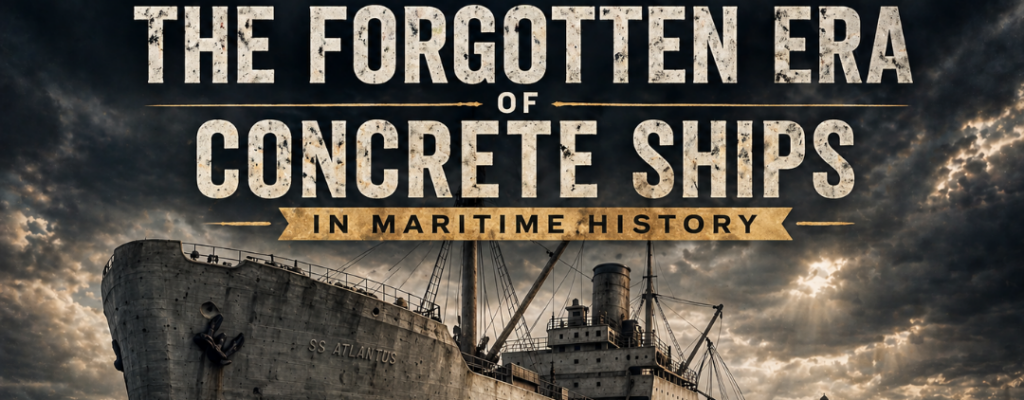
In modern shipping, steel is not questioned.
It is assumed.
But there was a time when steel was no longer available — and yet, cargo still had to move.
This is the story of one of the most unusual solutions in maritime history:
Concrete ships.
What Happened?
During World War I, global shipbuilding faced an unexpected crisis.
Steel — the backbone of ship construction — was diverted almost entirely to military use:
- Warships
- Tanks
- Weapons
Merchant shipping was left with a critical shortage.
At the same time, demand for cargo transport did not decrease.
It increased.
When and Where?
Between 1917 and 1919, several countries began experimenting with alternative shipbuilding materials:
- United States
- United Kingdom
- Norway
Shipyards were tasked with solving a simple but urgent problem:
How do you build ships without steel?
The Solution: Reinforced Concrete
Engineers turned to reinforced concrete — a material widely available and structurally reliable.
At first, the idea seemed impractical.
Concrete is:
- Heavy
- Rigid
- Difficult to repair at sea
But it had one key advantage:
It existed in abundance.
How Did They Work?
Concrete ships were designed differently from traditional vessels:
- Thicker hull structures
- Lower speed expectations
- Reduced cargo efficiency
Despite these limitations, they achieved something critical:
They floated.
And more importantly—
They transported cargo.
The Operational Reality
Concrete vessels were never ideal.
Compared to steel ships, they were:
- Slower
- Less fuel-efficient
- More limited in commercial flexibility
However, in a constrained environment, they fulfilled their purpose.
They kept cargo moving.
What Happened After the War?
Once steel production normalised, concrete ships quickly lost relevance.
Most were:
- Decommissioned
- Repurposed as storage units
- Abandoned
They became a temporary solution to a permanent problem.
The Strategic Lesson
This was not innovation driven by optimisation.
It was innovation driven by necessity.
When constraints become absolute, the objective changes:
From efficiency—
To continuity.
Modern commercial shipping practices continue to evolve within structured contractual frameworks such as the BIMCO charter party clauses.
Modern Relevance in Shipping
Today’s shipping market operates under different pressures:
- Cost efficiency
- Market timing
- Fleet optimisation
But extreme conditions still exist:
- Supply chain disruptions
- Resource shortages
- Geopolitical constraints
Global shipping disruptions and structural constraints are regularly analysed in reports such as the UNCTAD Maritime Transport Review.
In such environments, the question shifts again:
Not “What is optimal?”
But:
“What is possible?”
These types of structural challenges and responses are also reflected in broader industry practices outlined by the International Chamber of Shipping.
Practical Insight
Shipping is often seen as a system of precision.
But historically, it has also been a system of adaptation.
Concrete ships remind us that:
- Constraints redefine strategy
- Availability shapes decisions
- Movement takes priority over perfection
You can also explore current cargo movements and vessel positioning via our Market Insight page.
Final Thought
The concrete fleet was not built to compete.
It was built to function.
And in shipping, that distinction matters.
Because sometimes:
The ability to move cargo is more valuable than the ability to move it efficiently.