
The Cargo That Was Never Ready: A Hidden Risk in Chartering
Case Studies, Chartering Insights, Chartering Strategy, Shipping Strategy, Strategy Cargo Readiness, Chartering Risk, Demurrage, Dry Bulk, Freight Market, Maritime Strategy, Shipbroking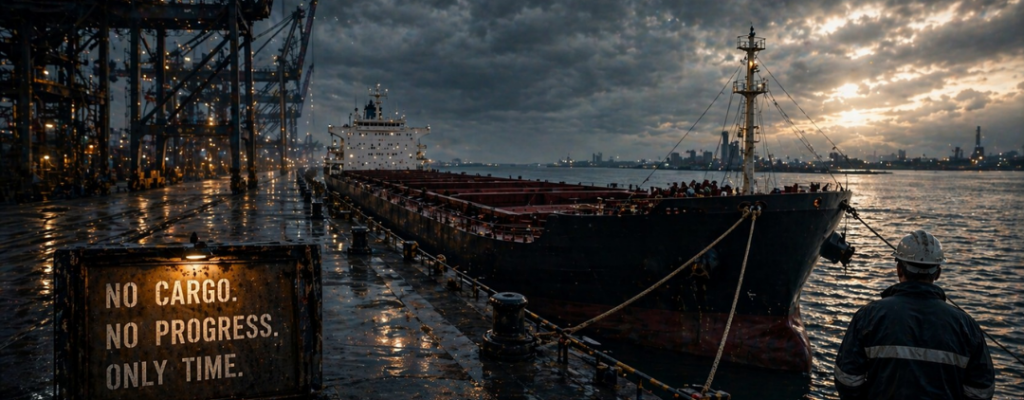
In shipping, some of the most expensive problems are not visible.
They are not written in the fixture recap.
They are not stated in emails.
They are not formally declared.
But they are there.
And they shape the entire operation.
The Scenario
A vessel is fixed for a routine bulk shipment.
- Cargo: Clinker
- Load port: East Mediterranean
- Discharge: West Africa
- Laycan: Tight but workable
Everything appears in order.
- Rate agreed
- Vessel nominated
- ETA confirmed
On paper, the deal is clean.
The Arrival
The vessel arrives on time.
Notice of Readiness (NOR) is tendered and accepted.
From a contractual standpoint:
Everything is valid.
But loading does not start.
The Delay Pattern
Day 1: Minor delay
Day 2: Operational issue
Day 3: Documentation
No cargo is loaded.
No clear explanation is given.
The vessel remains idle.
The Unspoken Reality
The cargo was never fully ready.
But this was never explicitly stated.
Why?
Because the commercial priority was different.
The Strategic Layer
In tight markets, charterers often prioritise securing tonnage.
Cargo readiness becomes secondary.
The logic is simple:
- Tonnage availability is uncertain
- Cargo preparation can be adjusted
So the sequence becomes:
Fix the vessel first.
Resolve cargo readiness later.
The Owner’s Position
From the owner’s perspective:
- NOR is accepted
- Laytime is running
- Demurrage will apply
Technically, the position is protected.
Contractual protections in such situations are typically based on widely used frameworks such as the BIMCO charter party clauses.
But commercially?
The picture is different.
The Hidden Cost
Demurrage compensates time.
It does not restore opportunity.
While the vessel waits:
- Next employment is missed
- Market positioning is lost
- Revenue potential shifts
The loss is not only operational.
It is strategic.
Similar inefficiencies and delays are reflected in broader global shipping patterns reported in the UNCTAD Maritime Transport Reports.
Risk Misalignment
This situation reveals a fundamental misalignment:
- Charterer risk → cargo readiness
- Owner risk → time exposure
- Broker risk → information gap
Each party operates with partial visibility.
Practical Insight
Experienced operators look beyond declared readiness.
They assess:
- Cargo preparation signals
- Terminal behaviour patterns
- Charterer track record
- Timing inconsistencies
Because in shipping:
What is not said often matters more than what is confirmed.
Operational inconsistencies and cargo readiness issues are also recognised within industry best practices outlined by the International Chamber of Shipping.
Decision Point
The critical question is not:
“Is the vessel ready?”
It is:
“Is the cargo truly ready — operationally, not contractually?”
Final Thought
Some risks in shipping are contractual.
Others are behavioural.
The most expensive ones are usually the second type.
Because a vessel can wait for cargo. But the market will not wait for the vessel.
You can also review current cargo flow and live positioning insights via our Market Insight page.