
Broker’s Notebook: What “Free DAs Bends” Actually Buys You
Dry Bulk Insights, Market InsightEvery dry bulk fixture note has a line about disbursement accounts, and most people read past it. That’s a mistake. “Free DAs bends” — free disbursement accounts both ends — is one of those clauses that looks like paperwork and behaves like a cost allocation decision.
Here’s what it actually means: the owner covers port disbursements — agency fees, pilotage, towage, the usual local charges — at both load and discharge ports, out of the freight already agreed. Nothing extra comes back to the charterer afterward. It sounds simple until a voyage runs into a port with unusually high agency fees, or a discharge port charges more than anyone expected, and suddenly someone is checking the fixture note to see whose problem that is.
The clause matters most when it’s silent, not when it’s written. A charterer builds their freight idea assuming DAs are included. An owner, working from a different template or a different trade, assumes they’re not. Nobody notices the gap until the final account lands and one side is short by a few thousand dollars they thought were covered. At that point it’s not a negotiation anymore — it’s a dispute over what was already agreed.
A broker who’s paying attention checks this before the fixture, not after. If a freight number looks soft compared to the route, the first question isn’t “why is this owner cheap” — it’s “does this rate include DAs or not.” A rate quoted free DAs bends and a rate quoted with DAs for charterer’s account can differ by a meaningful margin per ton, and comparing them side by side without checking the term is how a broker ends up recommending the wrong offer for the wrong reason.
It’s a small clause. It decides a real number. That’s most of what this job actually is.
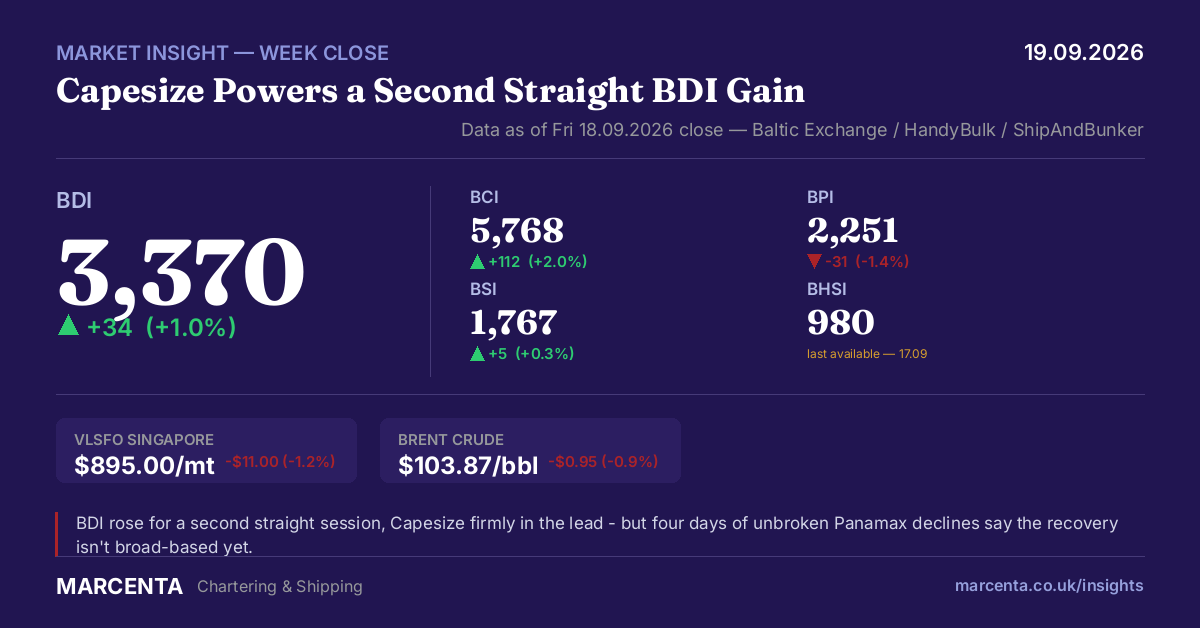
Market note: the Baltic Dry Index rose for a second consecutive session Friday (3,370, +1.0%), Capesize doing the pulling (BCI 5,768, +2.0%), while Panamax extended its losing run to four sessions (BPI 2,251, -1.4%, down 5.9% since 14 September) — a pattern consistent with reports of India trimming coal imports this year. (Source: Hellenic Shipping News, 19.09.2026)