
Anchorage Time by Segment: An Early Read from Our Own AIS Data
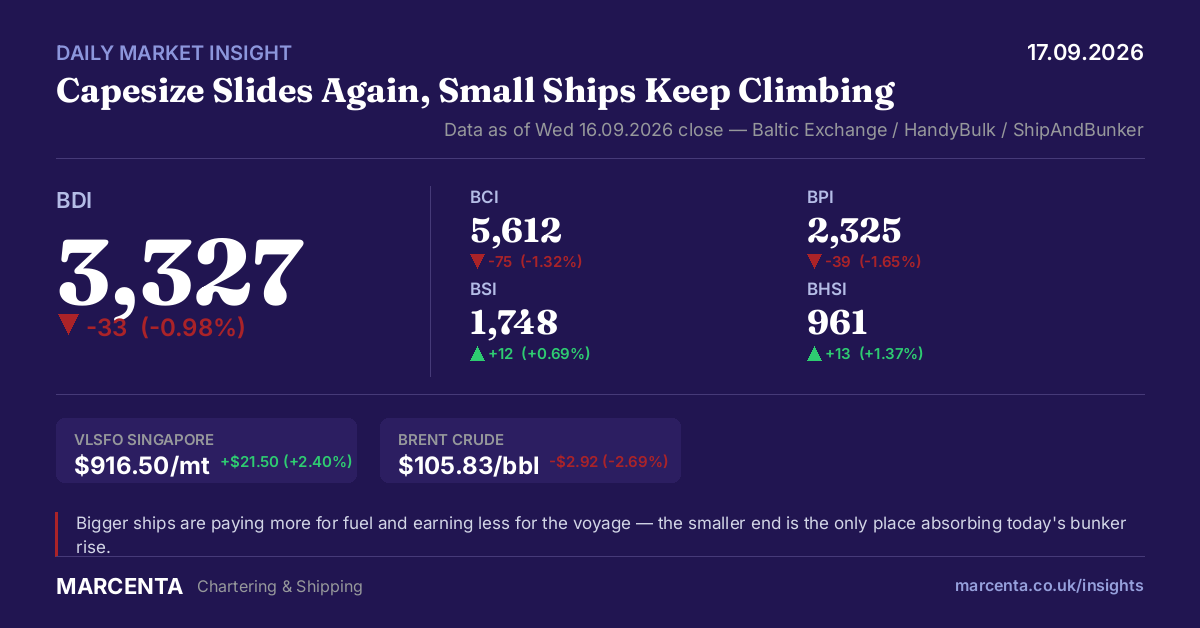
Dry Bulk Insights, Market InsightThe Baltic Dry Index has been drifting lower this week — 3,521 to 3,327 — but that headline number is doing a lot of hiding. Because the BDI leans heavily on Capesize, it masks a split market: Capesize (BCI 6,122 to 5,612, down 8.3%) and Panamax (BPI 2,409 to 2,325, down 3.5%) are cooling, while Supramax (BSI 1,713 to 1,748, up 2%) and Handysize (BHSI 931 to 961, up 3.2%) are actually firming. Source: handybulk.com, week to 16.09.2026.
On the cost side, bunkers are moving the wrong way for owners: VLSFO in Singapore is up 2.4% week on week to $916.50/mt, while Brent has slipped 2.7% to $105.83/bbl (shipandbunker.com, tradingeconomics.com). Higher fuel against softer big-ship rates squeezes voyage economics from both ends — and the smaller segments are the only ones currently absorbing that cost increase without losing ground on freight.
We spent some time this week looking at our own AIS tracking rather than the indices — specifically anchorage time by segment at Singapore in September. One thing stood out: Newcastlemax/VLOC and Handymax/Supramax vessels are showing noticeably higher and more spread-out anchorage times (averages near 30 hours, against medians closer to 18–20 hours) than Ultramax, Handysize or Panamax/Kamsarmax vessels in the same window. Worth being precise about what this is and isn’t: Singapore functions mainly as a bunkering and waypoint stop for dry bulk, not a discharge port, so this reads most likely as fuel queueing rather than cargo operations sitting idle. We wouldn’t treat it as a loading or discharge delay signal.
We’d also flag our own limits here. This is two weeks of our own AIS history, not a mature trend line, and the sample sizes vary a lot by segment (46 to 102 vessels tracked). We’re treating it as an early observation, not a conclusion — if the gap between average and median anchorage time in the larger segments persists into October, it becomes a pattern worth watching more closely.
Sources: handybulk.com (Baltic indices), shipandbunker.com and tradingeconomics.com (bunkers, Brent), Marcenta’s own AIS tracking (September 2026, early-stage sample).