
The Arctic Ghost Ship: A Sarcastic Lesson in Ultimate Vessel Endurance
Arctic Shipping, Global Trade, Global Trade & Geopolitics, Marine Insurance, Maritime History, Navigation & Safety, Operational Risk, Shipbroking Insights Arctic Exploration, Arctic Shipping, Ghost Ship, Hudson’s Bay Company, Marine Insurance, Maritime History, Operational Risk, Shipping Safety, SS Baychimo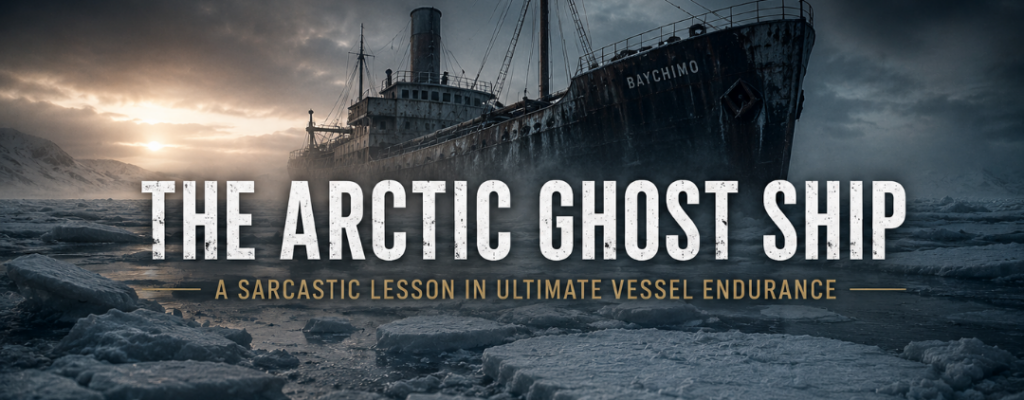
In modern commercial shipbroking, we obsess over real-time satellite tracking, instant ETA updates, and continuous communication with the master. If a vessel goes offline for even an hour, the chartering desk plunges into a minor panic. However, maritime history has a brilliant, slightly sarcastic way of reminding us that sometimes, a ship can manage perfectly well without any of us.
Meet the SS Baychimo—a steel-hulled cargo steamer that became the ultimate “Ghost Ship” of the twentieth century, navigating the treacherous Arctic waters completely unmanned for nearly four decades.
The Cargo That Got Cold
Built in 1914, the SS Baychimo was a solid, German-constructed vessel acquired by the Hudson’s Bay Company to trade furs with Inuit settlements along the northern coast of Canada. In October 1931, on a routine voyage packed with a valuable cargo of pelts, the vessel encountered an early, brutal winter.
Near Barrow, Alaska, the pack ice closed in like a vice. The hull was trapped, and the crew, fearing the ship would be crushed like an eggshell, abandoned her to camp on the ice. When a massive blizzard cleared days later, the ship was gone. The crew assumed she had sunk. They were wrong.
5W1H Breakdown of a 38-Year Drift
- Who: The SS Baychimo, an ordinary commercial cargo steamer turned extraordinary wanderer.
- What: Survived decades of shifting pack ice, freezing gales, and structural isolation without a single soul on board.
- Where: The remote, unyielding waters of the Chukchi and Beaufort Seas.
- When: Trapped in October 1931, she was sighted repeatedly by explorers, Inuit hunters, and other vessels until her last recorded appearance in 1969.
- Why it matters: Multiple salvage attempts were made over the years, but the shifting ice sheets protected her like a natural fortress, making boarding either too hazardous or legally impossible under shifting territorial claims.
- How it affects our perspective: She defied every rule of traditional marine insurance and hull degradation.
The Salvage Paradox
The irony of the SS Baychimo is that she proved more seaworthy when abandoned than many vessels are with a full complement of officers. She became a floating phantom, appearing unexpectedly out of the Arctic mist. For thirty-eight years, she remained a sovereign entity, drifting across maritime charts as a living hazard and an untamable ghost.
At Marcenta, when we look at modern global trade, we understand that technical risk management isn’t just about dealing with the hazards you can see on your screens; it is about respecting the raw, unpredictable power of the oceans.
While we aren’t currently fixing fur-trading steamers in northern Alaska, we apply that exact same respect and deep logistical oversight to every modern dry bulk fixture we manage today. We ensure your cargo is paired with a technically sound vessel, backed by a team that stays awake so your ship doesn’t have to navigate alone.
To explore how we actively manage non-ghost tonnage and match secure cargo today, visit our updated Market Insight & Activity page.
For historical records on 20th-century Arctic expeditions and trading posts, the Hudson’s Bay Company Archives provide extensive primary resources.
If you were a salvage master in the 1940s and spotted a rust-stained, crewless steamer packed with vintage furs drifting through the ice, would you risk your crew to board her, or leave the ghost to the Arctic? Was leaving her be a triumph of pragmatic safety or a failure of maritime ambition?
#ShipWithMarcenta