
Market Insight — 07.09.2026
Dry Bulk Insights, Market InsightDry bulk hits a five-year high, but the gains aren’t evenly spread
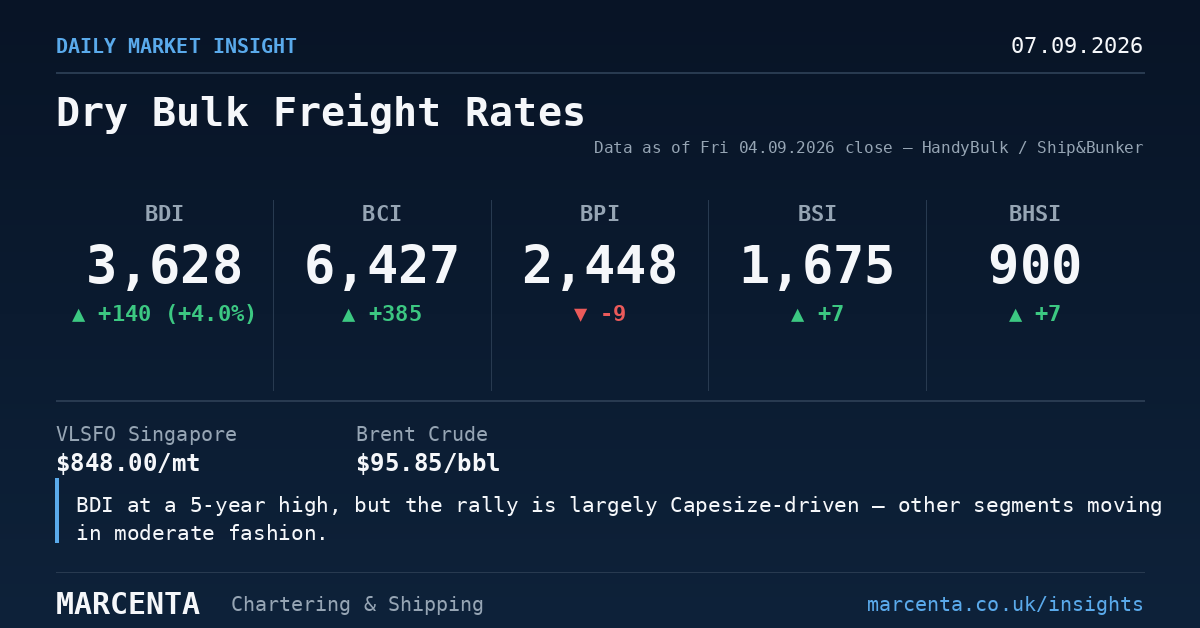
The Baltic Dry Index closed Friday at 3,628, up 140 points on the day and up nearly 15% over four sessions (3,157 to 3,628, September 1–4). That’s the highest BDI print since October 2021. On the surface, it reads as a broad dry bulk recovery. Underneath, it’s a narrower story.
Capesize did almost all the work. The BCI jumped 385 points Friday, pushing average daily earnings to $58,294, up $3,493 on the day. Panamax moved the other way, down 9 points to 2,448, with earnings essentially flat at $22,035. Supramax and Handysize both edged up but stayed close to where they started the week. When the big ships rally hard and the mid-size segments barely move, that’s a ton-mile story, not a demand story. Someone is sailing further, not necessarily loading more cargo.
Two things point to why. Black Sea dry bulk exports fell 42% between June-August versus March-May, with Russian wheat increasingly routed through Baltic ports instead, adding days to voyages that used to be shorter. Separately, Iran’s announcement of a new restricted zone near the Strait of Hormuz and the US Navy’s tanker escorts have pushed Hormuz transits to their lowest since May. Hormuz matters more for tankers than dry bulk, so treat this as a risk building in the background rather than a confirmed hit to Capesize supply. Still, both threads add distance to routes, and distance is what moves Capesize earnings.
Monday’s session gave the first hint that the rally needs watching: the BDI eased 53 points intraday, breaking the three-day climb, with Capesize down 2.2%. One session doesn’t undo a five-year high, but a rally built on rerouting rather than fresh cargo demand can unwind as fast as it built. Worth watching whether Panamax and Supramax start moving too, or whether Capesize keeps carrying the index alone.
Source: HandyBulk, Ship&Bunker, close of business Friday 04.09.2026. Monday intraday figures are provisional.