
Shipbroker Lesson: Weaponising Engine Slip to Defeat Falsified Deck Logbooks
Broker Lessons, Cargo Claims, Marine Claims, Shipbroker Lesson, Technical Claims AIS Vessel Tracking, Apparent Slip Formula, Charterparty Warranties, Engine Slip Math, Falsified Logbooks, Good Weather Clause, LMAA Arbitration, Marcenta Advisory, Marine Engineering Analytics, Post-Fixture Forensics, Propeller Pitch, RPM Data, Shipbroker Lesson, Speed and Consumption, Time Charter Disputes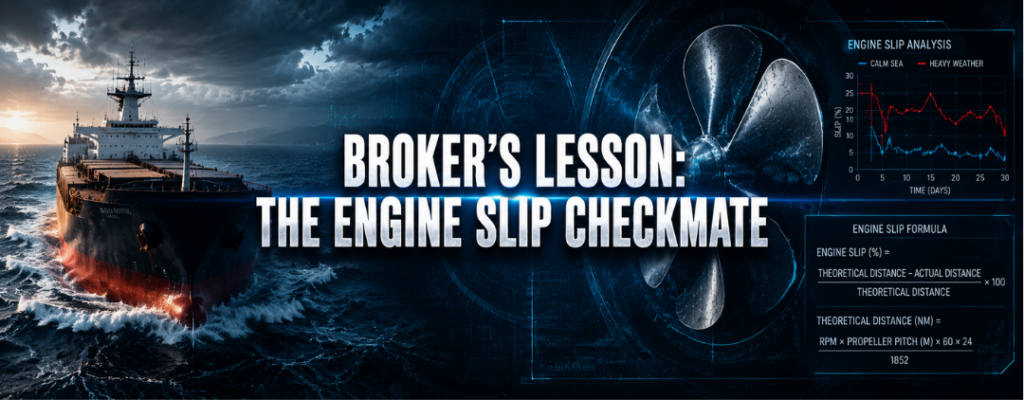
In the commercial management of time-chartered dry bulk fleets, the final performance audit is often where initial trading margins go to die. When a vessel underperforms, failing to maintain its contractually guaranteed speed or burning excess bunkers, a chartering desk expects a transparent financial recovery. Instead, they routinely encounter a legal wall erected by the Shipowner, built entirely on the phrase “Good Weather Only.”
Under English Maritime Law, a time-chartered vessel’s technical performance cannot be aggregated over the entire course of a long ballast or laden voyage. It is evaluated exclusively during highly specific, vetted windows that meet strict environmental criteria.
The primary structural legal defense for an Owner is the Master’s handwritten Deck Logbook. While a Master can easily manipulate weather descriptions with a stroke of a pen to protect the Owner’s asset efficiency, there is an unassailable law of hydrodynamics that no ink can ever disguise: The Engine Slip (Propeller Slip).
The Technical Blindspot: The Good Weather Camouflage
To u
nderstand why engine slip is an absolute forensic checkmate, one must deconstruct the traditional performance dispute. A standard time-charter rider clause mandates that a Supramax or Panamax vessel must maintain, for example, $13\text{ knots}$ on a daily consumption of $24\text{ metric tonnes}$ of VLSFO in “good weather.”
The legal catch is that “good weather” simultaneously demands a wind force of Beaufort 4 or lower, a Douglas Sea State 3 or lower, and absolutely no adverse swell. If a vessel executes a 20-day transit but the Master notes bad weather on 18 of those days, English law extrapolates the ship’s performance solely over the remaining 48 hours to decide a multi-thousand-dollar claim.
The fraud is simple: when a vessel suffers from a fouled hull, poor main engine maintenance, or the crew intentionally runs the auxiliary systems on an eco-revolution profile to save fuel for the Owner’s private account, the Master marks the Deck Logbook with fictitious entries: “Heavy rolling ocean swell, Beaufort Scale 5 headwinds, vessel laboring, speed reduced for safety.” In a traditional London Maritime Arbitrators Association (LMAA) arbitration room, unless a charterer can explicitly prove fraud, the Master’s logbook is historically tough to dethrone.
The Engineering Counter-Offensive: Calculating the Apparent Slip
This is where advanced marine engineering mathematics completely alters the legal balance of power. While a Master can lie about the wind force hitting the bridge, they cannot falsify the immutable physical relationship between the Main Engine’s Revolutions Per Minute (RPM), the physical Propeller Pitch, and the vessel’s true velocity recorded via independent satellite Automatic Identification System (AIS).
Engine Slip represents the percentage difference between the theoretical distance a ship should travel based on the mechanical rotation of its propeller screw through a solid medium, versus the actual physical distance she achieves through the water.
$$\text{Engine Slip (\%)} = \frac{\text{Theoretical Distance} – \text{Actual Distance}}{\text{Theoretical Distance}} \times 100$$
The theoretical distance per day is computed using the precise structural blueprint of the vessel’s propeller:
$$\text{Theoretical Distance (nm)} = \frac{\text{RPM} \times \text{Propeller Pitch (m)} \times 60 \times 24}{1852}$$
The Engine Slip Verification Matrix:
┌──────────────────────────────────────┐     ┌──────────────────────────────────────┐
│        The Falsified Deck Log        │     │       The Hydrodynamic Reality       │
├──────────────────────────────────────┤     ├──────────────────────────────────────┤
│ • Entry: "Beaufort 5, Adverse Swell" │     │ • Propeller Pitch: Constant          │
│ • Speed: Dropped to 10.5 Knots       │ vs  │ • Main Engine RPM: Normal / Constant │
│ • Defense: Weather Interruption      │     │ • Calculated Engine Slip: 3.5% (Calm)│
│ • Status: Legal Deadlock             │     │ • Conclusion: Falsification Proven   │
└──────────────────────────────────────┘     └──────────────────────────────────────┘
When a vessel genuinely encounters crushing headwinds or a heavy adverse ocean swell, the physical resistance against the hull skyrockets. The propeller spins against a massive counter-force, causing the apparent slip to jump significantly from a calm-sea baseline of $2\% – 6\%$ up to $15\% – 25\%$.
If the Deck Logbook claims heavy weather to justify a dramatic speed collapse, but a mathematical cross-reference of the engine’s actual RPM and Propeller Pitch reveals a slip ratio of just $3.5\%$, physics exposes the discrepancy instantly. A vessel cannot maintain a calm-sea slip profile while structurally battling a heavy storm. The math destroys the poker face.
The Marcenta Protocol: Digital Data Superiority
At Marcenta, when we enforce our core operating principle—Where cargo meets the right vessel—we refuse to let our clients’ commercial margins be paralyzed by administrative paperwork or falsified ink. We neutralize the logbook chess match by embedding definitive, high-tech engineering parameters directly into the pre-fixture contract phase:
- The Dual-Log Auditing Rider: We write custom clauses forcing Owners to provide complete, un-edited electronic copies of both the Deck Logbooks and the Chief Engineer’s Main Engine Performance Logs within 5 days of voyage completion.
- Automated AIS-Slip Cross-Referencing: We deploy real-time satellite tracking that automatically computes the daily apparent slip matrix, flagging performance anomalies before final hire or demurrage invoices are issued.
- Digital Precedence Over Ink: We structure maritime contract text ensuring that if a clear, mathematical conflict arises between manual journal notations and verified digital engine/satellite metrics, the physical engineering data legally supersedes the handwritten log. We secure your capital with science.
We are actively covering:
• Black Sea
• Mediterranean
• Continent
• WAF
Cargoes and open vessels are always welcome.
chartering@marcenta.co.uk
#ShipWithMarcenta
CONTINUE YOUR LEARNING
Test what you just read in a live-style case, or look up the exact term in our Terms and Rules library.
Play a CaseTerms and Rules