Study Case: The Case of the Self-Heating Coal & The Master’s Refusal
Case Analysis, Case Studies, English Law, Maritime Law #ShipWithMarcenta, Bulk Coal, Cargo Refusal, Demurrage Risk, IMSBC Code, Laytime Dispute, Maritime Arbitration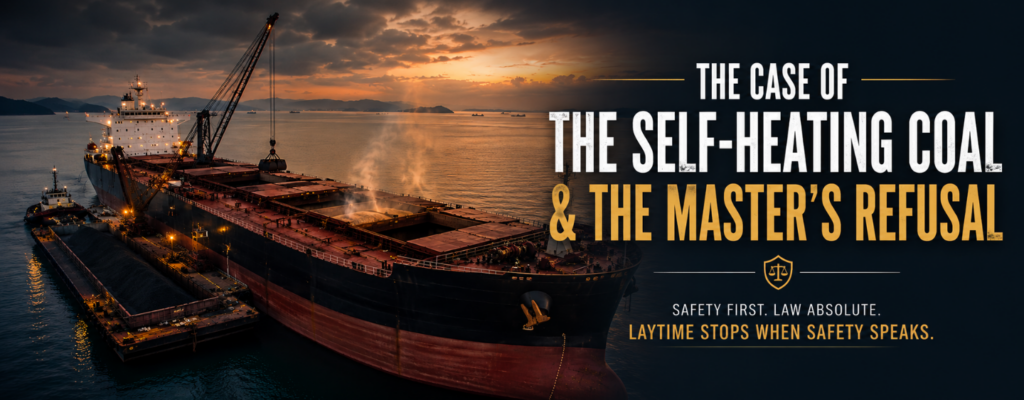
Welcome to another technical case study from the Marcenta desk, where we dissect the intense friction between commercial chartering pressures and strict international maritime safety conventions. Today’s puzzle analyzes a classic time-counting conflict in the bulk sector: when a cargo’s natural chemical characteristics cross the line into an immediate structural hazard.
The Scenario
A modern Kamsarmax vessel, the MV Marcenta Pioneer, arrives at a busy anchorage in Kalimantan, Indonesia, under a voyage charter party to load a full cargo of bulk steam coal for discharge in Mundra, India. The Charter Party incorporates standard terms along with the Hague-Visby Rules, explicitly mandating compliance with the International Maritime Solid Bulk Cargoes (IMSBC) Code.
During the loading operation via intermediate barges, the ship’s crew executes routine temperature checks using calibrated digital probes. Suddenly, the readings from a specific batch of coal arriving alongside spike dramatically, registering a temperature of +58°C.
Recognizing an extreme risk of spontaneous combustion, toxic carbon monoxide emission, and methane gas accumulation, the Master immediately invokes his overriding authority under SOLAS and halts the loading operation, officially refusing to accept the hot coal on board.
The Commercial Standoff
The Charterer and the local mining terminal instantly launch a bitter commercial protest, presenting their own third-party infrared reports which claim the “average” temperature of the stockpile is within acceptable boundaries.
The Charterer asserts the following arguments:
- The Cargo Characteristic: Steam coal from this region inherently possesses a propensity to self-heat, and this commercial reality was fully known to the Owner at the time of fixing.
- The Mechanical Duty: The vessel is equipped with mechanical surface ventilation systems designed specifically to handle gas emissions and control hold atmospheres during the transit.
- The Time Count: The Charterer declares that the Master’s refusal constitutes an “unjustifiable operational stoppage.” Consequently, they insist that the laytime clock continues to run uninterrupted and threaten to hold the Owner liable for all consequential barge detention fees.
The IMSBC Code Temperature Threshold Matrix:
┌────────────────────────────────────────────────────────┐
│             Coal Temperature Checked at Barge          │
└───────────────────────────┬────────────────────────────┘
                            │
               Is the reading ABOVE +55°C?
            ┌───────────────┴───────────────┐
            ▼                               ▼
       [ YES ]                           [ NO ]
  Absolute Statutory Prohibition.    Safe to accept under
  Master MUST refuse loading.        standard monitoring.
            │                               │
            ▼                               ▼
 [ Laytime/Demurrage Standoff: ]    [ Normal Operation Continuous ]
 [ Charterer runs the risk due ]
 [ to tendering defective cargo ]
The Legal Architecture: Who Dominates the Dispute?
Under English Maritime Law and the mandatory framework of the IMSBC Code, the position regarding hot coal is clinical and absolute. The Code explicitly dictates that coal with a temperature exceeding +55°C shall not be accepted for loading. Because this is a statutory safety threshold, a charterer cannot use private commercial agreements or rider clauses to override an international convention.
- The Overriding Authority: The Master’s decision to halt operations is protected by international public law. When a charterer tenders a cargo that exceeds statutory safety limits, they are in breach of their fundamental obligation to provide a safe, shippable commodity.
- The Laytime Defection: A charterer cannot claim that laytime continues to run during a delay that they directly caused by presenting non-compliant cargo. Because the vessel was prevented from loading due to the defective nature of the tendered goods, the time spent waiting for the terminal to cool down or replace the hot spots is completely excluded from laytime.
- The Absolute Risk: If the Master had yielded to commercial pressure and accepted the cargo, and a subsequent fire broke out at sea, the Owner would likely be deemed to have failed in their non-delegable duty to exercise due diligence to make the ship seaworthy under Article III(1) of the Hague-Visby Rules, destroying their insurance protection.
How Marcenta Insulates Your Fixtures
The ironical reality of the dry bulk market is that trading desks routinely review average cargo declarations without investigating the localized sampling protocols at the loading berth, leaving their entire fixture exposed to sudden terminal blockades.
At Marcenta, when we execute our core commitment of Where cargo meets the right vessel, we run a pre-emptive operational audit. We ensure that our chartering contracts contain ironclad IMSBC compliance clauses that explicitly penalize the charterer for tendering cargo exceeding +55°C.
By defining exactly how time, shifting expenses, and replacement costs are allocated the moment a digital probe triggers an alarm, we protect our clients from the massive financial fallout of a cargo standoff. We bridge the gap between rigorous safety laws and transactional certainty.
To review our current, fully audited positions and secure reliable dökme yük (dry bulk) tonnage backed by highly trained operational crews, visit our active Market Insight & Activity portal.
For the complete statutory schedules, emergency response procedures, and entry regulations governing coal carries, reference the latest bulletins published by the International Maritime Organization (IMO).
#ShipWithMarcenta