What If!? — The Two-Hour Legal Standoff That Blackened the Coast of Brittany
Cargo Operations, Maritime History, Maritime Law, Maritime Operations, Risk Management in Trade Amoco Cadiz, Chartering, Dry Bulk, Emergency Response, Environmental Liability, Lloyds Open Form, LOF, Marine Insurance, Maritime Claims, Maritime Law, Maritime Operations, Maritime Salvage, Oil Spill, Salvage Arbitration, SCOPIC, Shipbroking, Shipping History, Shipping Risk, Tanker Shipping, VLCC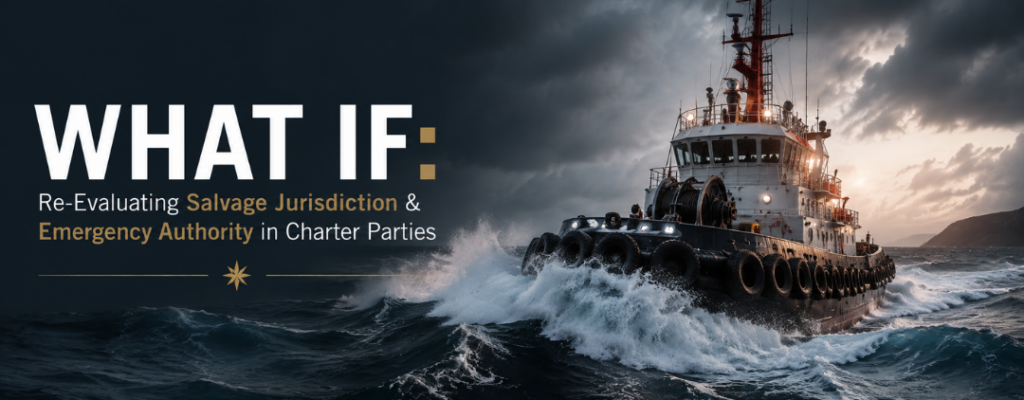
In modern dry bulk and liquid chartering, the phrase “No Cure, No Pay” is tossed around with casual professional familiarity. We treat the Lloyd’s Open Form (LOF) as a standard, off-the-shelf contract designed to instantly protect life, property, and the environment during a maritime casualty. However, maritime history loves to remind us that the absolute certainty of a standard legal form was bought with the price of catastrophic operational hesitation.
Go back to March 1978, off the coast of Brittany, France. The VLCC Amoco Cadiz, fully laden with 220,000 tonnes of crude oil, suffers a catastrophic steering gear failure in a severe storm. She is drifting helplessly toward a rocky lee shore.
Enter the German salvage tug Pacific. The tug captain arrives, assesses the massive risk, and offers to connect the towline immediately. But there is a catch: he demands the execution of a Lloyd’s Open Form contract, which would submit the ultimate salvage award to a panel of expert arbitrators in London under English Law.
The Master of the Amoco Cadiz, bound by corporate communication protocols, refuses to sign immediately. He spends two critical hours radioing his management desk in Chicago, trying to negotiate a standard commercial towage rate to save money. By the time the authorization arrives and the towline is connected, the weather has deteriorated, the line snaps, and the vessel grounds, triggering one of the worst environmental disasters in history.
At Marcenta, we look back at this tragedy through a sharp, analytical lens: What if the Master had ignored corporate red tape, signed the LOF instantly, and accepted English Law jurisdiction without delay?
The Amoco Cadiz Standoff Framework:
┌────────────────────────────────────────────────────────┐
│             Steering Failure in Brutal Gale            │
└───────────────────────────┬────────────────────────────┘
                            │
               The Two-Hour Contract Debate
            ┌───────────────┴───────────────┐
            ▼                               ▼
    [ REALITY: Chicago Delay ]       [ WHAT IF: Instant LOF ]
  Debating commercial towage rates.  Immediate salvage connection
  Result: Towline snaps, VLCC ruins. under English Law jurisdiction.
            │                               │
            ▼                               ▼
 [ Shockwave: Modern CLC Regs ]   [ Status Quo: Salvage Law  ]
 [ & Strict Liability Rules    ]   [ Retains Traditional Form ]
1. The Butterfly Effect on Marine Insurance and Salvage Incentives
If the Amoco Cadiz had been successfully towed to safety under an instant LOF contract, the salvage award decided in London would have been massive, but the ship and cargo would be intact.
Without this disaster, the international maritime community wouldn’t have faced the shocking realization that the traditional “No Cure, No Pay” model actually discouraged salvors from intervening in environmental crises where the ship itself was likely a total loss.
The catastrophic delay of the Amoco Cadiz directly forced the creation of the 1989 Salvage Convention and, eventually, the SCOPIC (Special Compensation P&I Club Clause) clause. Without those two hours of corporate hesitation, the financial framework that compensates modern salvors for preventing environmental damage—regardless of whether the ship is saved—would have lagged by decades.
2. The Onerous Evolution of ‘Strict Liability’
The legal fallout of the Amoco Cadiz trial in Chicago dragged on for years, establishing the precedent that a shipowner could be held liable for astronomical damages beyond the traditional limits of liability if operational communication lines were deemed unseaworthy.
If the contract had been executed immediately under English Law arbitration, the limits of liability might have retained their traditional boundaries. Instead, the disaster accelerated global implementation of strict liability regimes like the Civil Liability Convention (CLC), transforming the way marine insurance desks calculate risk management exposure for modern fleets today.
How We De-Risk the Transactional Chain
The sarcastic truth of the Amoco Cadiz is that two hours of long-distance corporate negotiation over a towage fee cost the industry billions of dollars in subsequent regulatory compliance.
At Marcenta, when we implement our guiding principle of Where cargo meets the right vessel, we actively analyze the emergency response and decision-making structures of the operators we fix.
We ensure that your charter parties contain clear, uninhibited clauses regarding the Master’s overriding authority to execute salvage agreements like the LOF or SCOPIC instantly during an incident. We don’t just match steel with cargo; we protect your supply chain from the fatal friction of corporate bureaucracy when the storm hits.
To explore how we map out secure routes and partner with operationally elite owners who possess decisive emergency structures, review our Market Insight & Activity portal.
For a complete breakdown of modern salvage parameters, arbitration rules, and standard form updates, we recommend visiting the official Lloyd’s Open Form Committee.
#ShipWithMarcenta