
Sailing Too Early: When Leaving on Time Creates Delay
Chartering Strategy, Maritime Operations, Shipping Insights, Strategy Chartering, Dry Bulk, Freight Market, Maritime Operations, Shipbroking, Shipping Strategy, Voyage Planning, Weather Risk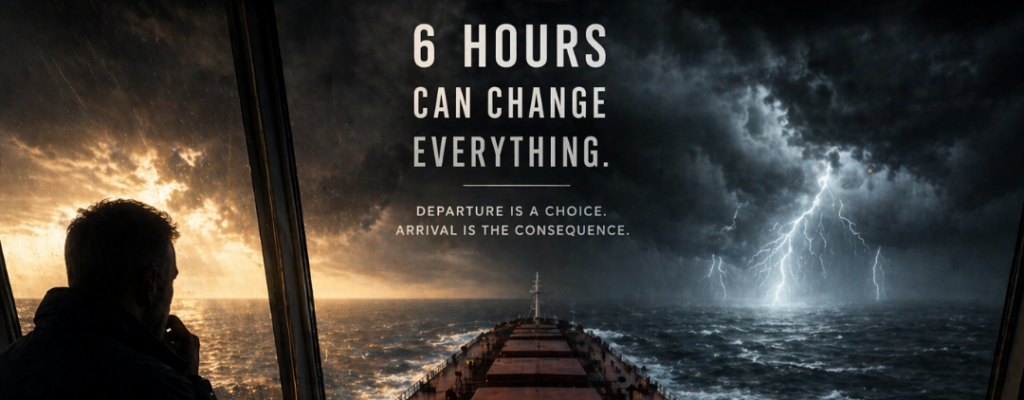
In shipping, efficiency is often measured by one visible action:
Departure.
A vessel that sails on time appears efficient.
A vessel that waits appears delayed.
But what if that logic is flawed?
The Scenario
A bulk carrier completes loading in the Black Sea.
- Cargo: Steel products
- Route: Black Sea → Mediterranean
- Laycan pressure: High
- Weather forecast: Deteriorating
The vessel is operationally ready.
Clearance obtained.
Cargo secured.
Orders received.
The decision becomes binary:
Sail now — or wait.
The Illusion of Efficiency
From a commercial perspective, sailing immediately seems logical.
- No idle time
- Charter expectations met
- Schedule maintained
But this logic focuses on departure.
Not arrival.
What Happens at Sea
Shortly after departure, conditions deteriorate faster than expected:
- Wind force increases
- Vessel speed drops
- Course adjustments required
- Rolling affects cargo stability
The voyage continues — but not as planned.
The Real Cost of Early Sailing
What was intended as a time-saving decision results in:
- Slower overall passage
- Missed berthing window
- Congestion exposure on arrival
- Potential demurrage implications
The vessel did not lose time at port.
It lost time at sea.
The Alternative Scenario
If departure had been delayed by a few hours:
- Weather stabilisation could be achieved
- Optimal speed maintained
- Arrival window secured
- Cargo risk reduced
Same vessel.
Same cargo.
Different outcome.
Departure vs Arrival Thinking
This scenario highlights a structural misunderstanding:
Shipping decisions are often optimised for departure.
But commercial outcomes depend on arrival.
The difference is subtle — but critical.
Voyage planning and operational decisions are often structured around standard industry frameworks such as the BIMCO charter party clauses.
Strategic Perspective
Experienced operators assess more than readiness.
They evaluate:
- Weather progression, not just current conditions
- Voyage impact, not just departure timing
- Arrival positioning, not just sailing status
Because in shipping:
A delayed departure can still result in an optimal arrival.
Operational decision-making in such conditions is also influenced by best practices outlined by the International Chamber of Shipping.
The Hidden Risk
The real risk is not waiting.
It is moving under imperfect conditions.
Early departure under marginal conditions can:
- Multiply delays
- Increase operational stress
- Reduce commercial efficiency
And these effects compound over the voyage.
These patterns align with broader maritime risk observations published in the UNCTAD Maritime Transport Reports.
Practical Insight
The most effective decisions in shipping are not always visible.
They are often the ones not taken.
Choosing when not to sail can be more valuable than sailing on time.
Final Thought
In shipping, movement is easy to measure.
Timing is not.
The real question is not:
“When did the vessel leave?”
It is:
“When did the vessel arrive — and under what conditions?”
You can also explore our latest live cargo and tonnage positioning via our Market Insight page.