Toward a Third World War?
Energy Markets, Geopolitics, Global Trade, Global Trade & Geopolitics, Maritime Analysis, Market Insight, News & Insights, Shipping Market belt and road initiative, china oil imports, energy geopolitics, energy trade routes, freight market analysis, global energy sanctions, global shipping routes, global supply chains, maritime geopolitics, semiconductor supply chain, strait of hormuz shipping, taiwan microchip industry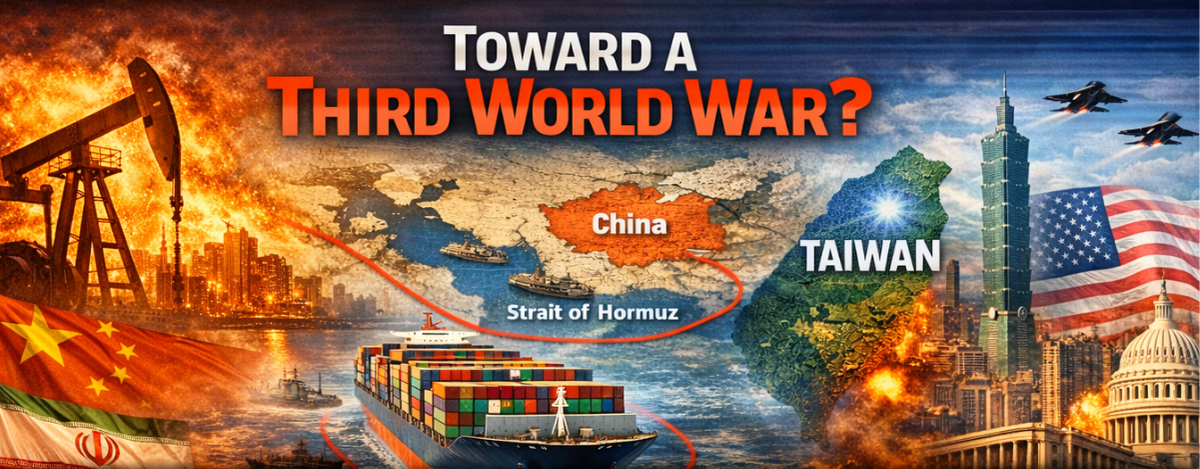
Introduction
When trying to understand global geopolitics, we often focus on military operations or political crises. However, at Marcenta Chartering, we believe that these events are often symptoms of a deeper strategic transformation whose impact will also be felt in the maritime industry.
Behind many geopolitical developments lies a broader competition: control over the energy, technology and logistics supply chains that power modern economies.
Today, this competition sits at the center of the strategic rivalry between the world’s two largest economic powers.
China is currently the largest manufacturing economy in the world and also the largest crude oil importer globally. According to the International Energy Agency (IEA), China imports more than 11 million barrels of oil per day, making energy security a critical factor for its industrial output.
Source:
https://www.iea.org
Venezuela
Venezuela holds one of the largest proven oil reserves in the world. For many years, China has been one of the major buyers of Venezuelan crude oil.
In some periods, Chinese imports from Venezuela exceeded 600,000 barrels per day, according to energy market data.
However, the political crisis in Venezuela and the U.S. support for opposition movements against the Maduro government, combined with extensive sanctions on Venezuela’s oil sector, significantly disrupted this trade and reduced the country’s ability to export oil to international markets.
Some observers welcomed the pressure against the Maduro administration, while others criticized it as a violation of international law. Yet relatively few discussions focused on how these developments affected China’s energy supply from Venezuela.
Source:
https://www.reuters.com/business/energy/us-sanctions-venezuela-oil
Russia
Russia is another major energy supplier to China.
Following Russia’s invasion of Ukraine in 2022, the United States and its Western allies imposed sweeping sanctions on the Russian economy, particularly targeting the energy and financial sectors.
These sanctions significantly reshaped global energy trade. Russian oil exports increasingly shifted toward Asian markets such as China and India, often at discounted prices.
At the same time, the sanctions regime introduced new complexities and uncertainties in global oil trading flows and maritime logistics.
Source:
https://www.brookings.edu/articles/how-sanctions-on-russia-work
Iran
Iran is also a critical oil supplier for China.
Between 2024 and 2025, China’s imports of Iranian crude were estimated at around 1.3–1.5 million barrels per day, making China the largest buyer of Iranian oil.
Source:
https://www.reuters.com/business/energy/chinas-heavy-reliance-iranian-oil-imports
However, Iran has been under long-standing U.S. sanctions related to its nuclear program and regional policies.
In addition, rising military tensions in the region — including direct confrontations involving the United States and Israel against Iranian targets — have increased instability across the Persian Gulf.
These tensions are particularly significant because they threaten shipping routes around the Strait of Hormuz, one of the world’s most critical oil transit chokepoints.
Any disruption in this corridor would immediately affect global energy supply chains.
Iran and the Modern Silk Road
Iran is not only an energy supplier to China; it is also a strategic node in China’s Belt and Road Initiative (BRI), sometimes referred to as the modern Silk Road.
China has invested billions of dollars into infrastructure projects including railways, ports, pipelines and logistics corridors connecting Asia to Europe.
Due to its geographical position, Iran serves as a critical transit corridor linking Central Asia, the Middle East and European markets.
However, geopolitical tensions, sanctions and military instability in the region have complicated China’s long-term infrastructure and trade ambitions.
Source:
https://www.worldbank.org/en/topic/regional-integration/brief/belt-and-road-initiative
Saudi Arabia
Saudi Arabia is another major oil supplier to China.
According to U.S. Energy Information Administration (EIA) data, Saudi Arabia has consistently ranked among China’s top energy partners.
Source:
https://www.eia.gov/international
Given the evolving geopolitical environment and competition over energy supply chains, some analysts have begun asking a broader question:
Could future geopolitical competition also influence Saudi Arabia’s role in global energy markets?
The answer remains uncertain, and we leave the interpretation of this possibility to our readers.
Microchips, Taiwan and the Hidden Technology War
Beyond energy markets, another critical dimension of global competition lies in the semiconductor industry.
Taiwan, led by semiconductor pioneer Morris Chang, has become the dominant global player through the company TSMC (Taiwan Semiconductor Manufacturing Company).
TSMC operates under a “design-manufacture” model, producing chips designed by major global technology firms.
Today, TSMC manufactures semiconductors used by companies and institutions ranging from Apple and Nvidia to defense and aerospace contractors working with NASA and the Pentagon.
Semiconductors have become the foundation of modern technologies including:
• artificial intelligence
• high-performance computing
• advanced defense systems
However, semiconductor manufacturing requires enormous quantities of ultra-pure water.
This creates a unique challenge for Taiwan: balancing industrial dominance with environmental sustainability and agricultural water needs.
This dilemma raises a fundamental question for Taiwan’s future:
Should priority be given to economic power or essential natural resources?
China’s tensions with Taiwan are often framed around the political concept of “One China.”
However, control over the global semiconductor supply chain is widely seen as another critical factor shaping this rivalry.
The Strategic Question
Looking at the bigger picture, an important question emerges:
Is the United States attempting to slow the rise of its largest economic competitor, China?
Or is Washington primarily focused on protecting Taiwan — the island that produces the majority of the world’s advanced microchips, which power critical American industries and defense systems?
Maritime Industry Perspective
From a maritime perspective, these developments carry significant implications.
More than 90% of global trade moves by sea, meaning that changes in energy flows, supply chains and trade corridors inevitably reshape shipping routes.
If global supply chains shift, we may see:
• changes in shipping routes
• container allocation imbalances
• vessel positioning challenges
• increased freight volatility
These dynamics could lead to higher freight rates across both container and dry bulk markets.
We are already seeing signs of pressure in freight markets as rising Brent crude prices — recently approaching $90 per barrel — affect operating costs and shipping economics.
Source:
https://www.eia.gov
This has also contributed to fluctuations in major dry bulk indices such as:
• Baltic Dry Index (BDI)
• Baltic Supramax Index (BSI)
• Baltic Handysize Index (BHSI)
Source:
https://www.balticexchange.com
Long-Term Technology Impact
In the longer term, a potential semiconductor supply crisis could also impact the maritime sector in unexpected ways.
Today, artificial intelligence already plays a major role in shipping operations:
• route optimization
• freight calculation
• AIS vessel tracking
• digital freight exchanges
If semiconductor shortages increase the cost of AI technologies, the industry may experience a partial return to traditional know-how driven decision making.
The Marcenta Approach
At Marcenta, we combine over 20 years of industry experience, strong market know-how and controlled tonnage to provide traders and cargo owners with reliable solutions.
While technology continues to transform the industry, experience, market intelligence and strategic analysis remain the foundation of successful shipbroking.
Because when global supply chains shift, freight markets follow.
And those who read the signals early position themselves where cargo meets the right vessel.